Outdoor Gear Market: Why Inflatable Tents Are Becoming Mainstream?
Time:2026-06-30
Pageviews:0
Outdoor Gear Market: Why Inflatable Tents Are Becoming Mainstream
The outdoor gear industry is undergoing a significant transformation. From traditional pole structures to lightweight modular systems, innovation continues to redefine how people camp, travel, and set up temporary shelters. Among these developments, inflatable tents are rapidly emerging as a mainstream choice for both recreational users and commercial operators.
As a professional supplier of inflatable tent systems—specializing in PVC tarpaulin (PVC-coated mesh fabric) continuous-air and sealed-air structures—we have seen firsthand how market demand is shifting toward safer, faster, and more durable inflatable solutions.
1. Faster Setup, Lower Labor Requirements
One of the strongest drivers behind the rise of inflatable tents is efficiency.
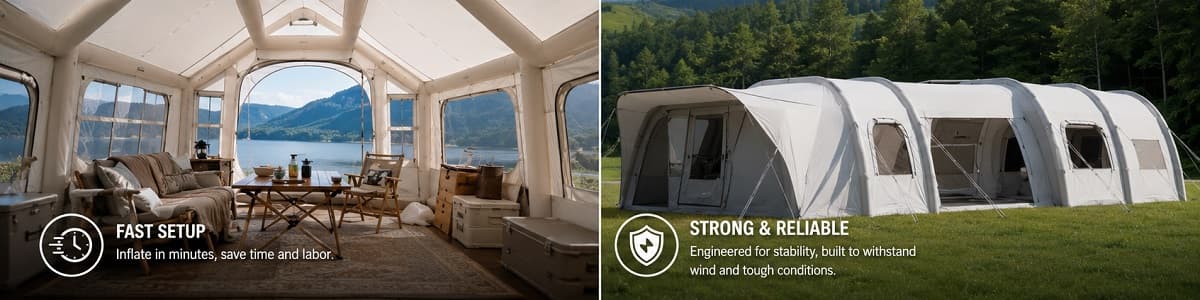
Traditional tents rely on aluminum or fiberglass poles, which require assembly, alignment, and time-consuming setup. In contrast, inflatable tents use air-beam structures that can be deployed in just a few minutes using an electric or manual pump.
For commercial operators such as event organizers, rental companies, and emergency response teams, this advantage directly translates into:
- Reduced labor cost
- Faster deployment time
- Easier training for staff
- Higher turnover efficiency in large-scale events
In today’s fast-paced outdoor industry, time savings have become a critical competitive advantage.
2. Improved Structural Safety and Wind Resistance
Modern inflatable tent systems are engineered with reinforced air beam structures that distribute pressure evenly across the frame. This results in excellent stability under varying weather conditions.
Compared with traditional pole tents, inflatable structures offer:
- Fewer rigid break points
- Better shock absorption under wind load
- Reduced risk of structural collapse from joint failure
- Improved safety in crowded public environments
For commercial applications such as festivals, exhibitions, and outdoor marketing events, safety and reliability are essential factors in product selection.
3. Material Upgrades: Durability Meets Performance
Material technology is another key factor driving adoption.
High-quality inflatable tents today are typically made from PVC tarpaulin (PVC-coated mesh fabric), which provides:
- High tear strength
- Excellent waterproof performance
- UV resistance for long-term outdoor use
- Easy surface cleaning and maintenance
Depending on product design, two major structural types are widely used:
Continuous Air (Constant Inflation) Systems
These tents use heavy-duty PVC material, typically around 0.55–0.60 mm thickness, and are designed to remain inflated during use with a continuous air blower. They are ideal for:
- Large event tents
- Advertising structures
- Long-duration outdoor installations
Sealed Air (Air-Tight) Systems
These systems are built with thicker material, often up to 0.9 mm PVC, and are inflated once, then sealed. They are preferred for:
- Remote camping
- Emergency shelters
- Energy-saving applications where power is limited
Both systems offer distinct advantages depending on usage scenarios, giving users flexibility across different environments.
4. Growing Demand from Commercial and Rental Markets
Inflatable tents are no longer limited to recreational camping. The commercial market is now one of the fastest-growing segments.
Key demand drivers include:
- Outdoor festivals and exhibitions
- Brand activation and promotional events
- Tourism and glamping resorts
- Government emergency response systems
- Equipment rental businesses
Rental operators in particular appreciate inflatable tents because they are:
- Easy to transport and store
- Quick to set up and dismantle
- Highly customizable for branding and size
- Durable enough for repeated use cycles
This makes them a high-return investment product in the outdoor equipment industry.
5. Design Flexibility and Customization
Unlike traditional tents with fixed pole geometry, inflatable structures offer far greater design freedom. Manufacturers can easily produce:
- Dome-shaped tents
- Tunnel-connected systems
- Large inflatable event halls
- Themed promotional structures
- Modular expandable camping systems
For commercial users, this flexibility allows strong brand visibility and unique visual impact—especially important in crowded outdoor environments.
6. Lower Transportation and Storage Costs
Inflatable tents significantly reduce logistics complexity. When deflated, they occupy far less volume compared to rigid-frame structures.
This results in:
- Lower shipping costs
- Easier warehouse storage
- Reduced transportation damage risk
- More efficient inventory management
For global distributors and rental companies, these advantages directly improve operational margins.
7. The Future: Smarter, Stronger, More Sustainable
As material science and air structure engineering continue to evolve, inflatable tents are expected to become even more advanced.
Future trends include:
- Lightweight high-strength composite PVC fabrics
- Integrated ventilation and climate control systems
- Faster inflation technology
- More sustainable and recyclable material options
- Smart monitoring for air pressure and safety control
These innovations will further strengthen inflatable tents as a core product category in the outdoor equipment market.
Conclusion
The rise of inflatable tents is not a temporary trend—it reflects a structural shift in the outdoor equipment industry toward efficiency, safety, and versatility.
With continuous improvements in PVC tarpaulin materials, structural engineering, and product design, inflatable tents are becoming the preferred solution for both commercial and recreational users worldwide.
As a professional manufacturer and supplier, we remain committed to delivering high-performance continuous-air and sealed-air inflatable tent systems that meet the evolving needs of the global outdoor market.
About WINSUN Tents:
WINSUN Tents combines 19+ years of PVC manufacturing expertise with innovative inflatable engineering to deliver premium temporary structures for clients worldwide. From advertising tents to emergency shelters, we build solutions that outperform expectations.
Consultation Inquiries:
Email: info@winsuntent.com
Website: www.winsuntent.com