Commercial Opportunities and Challenges of Inflatable Tents in the Outdoor Activity Industry
Time:2026-06-23
Pageviews:0
Commercial Opportunities and Challenges of Inflatable Tents in the Outdoor Activity Industry
As outdoor leisure, event management, and experiential marketing continue to expand globally, the commercialization of outdoor activities is accelerating at an unprecedented pace. Within this trend, inflatable tents have emerged as a highly flexible, cost-effective, and visually impactful solution for both temporary and semi-permanent outdoor structures.
As a professional supplier of PVC tarpaulin inflatable tent systems—including both continuous air (constant air) structures and airtight sealed (air retention) designs—we see strong market growth driven by evolving user demands, while also recognizing several important challenges that manufacturers and operators must address.
1. Market Growth Driven by Outdoor Commercialization
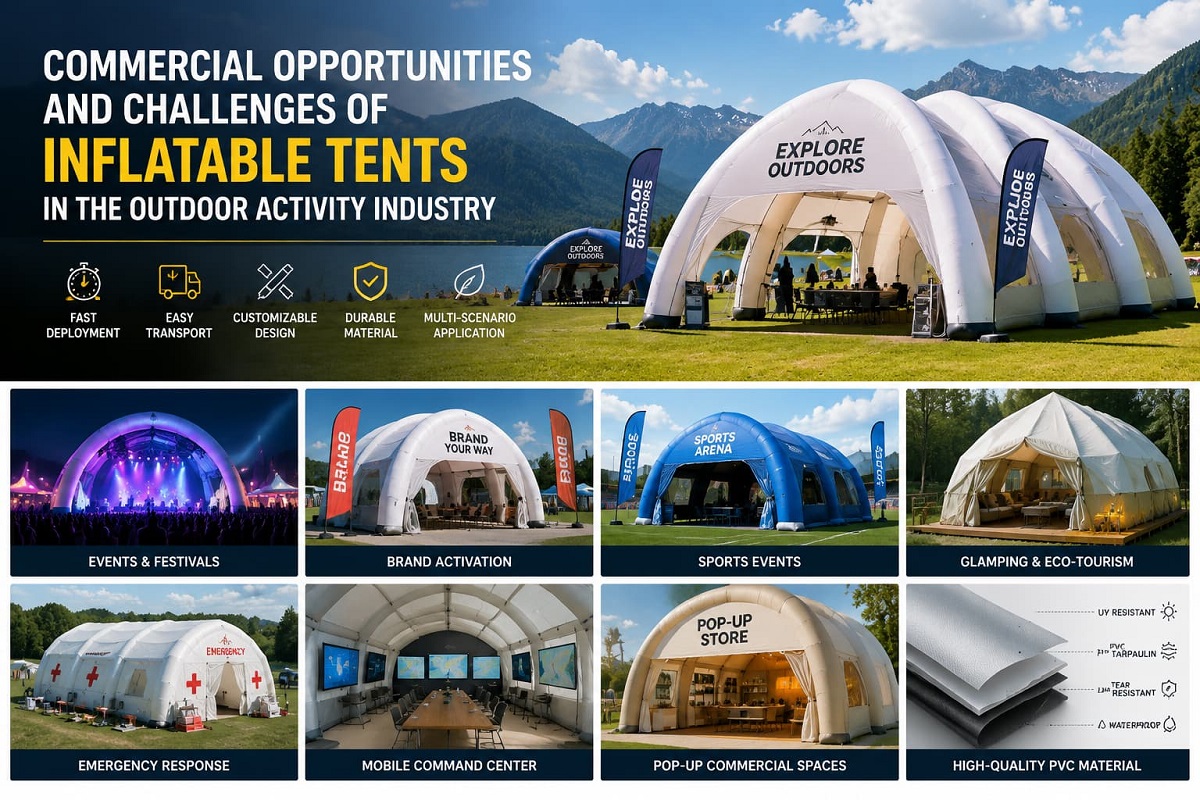
Outdoor activities are no longer limited to traditional camping or leisure use. Today, they are widely integrated into:
• Music festivals and cultural events
• Brand activation and marketing campaigns
• Sports events and fan zones
• Emergency response and mobile command stations
• Glamping resorts and eco-tourism projects
• Pop-up commercial spaces and exhibitions
This diversification is significantly increasing demand for modular, fast-deploying structures. Inflatable tents, due to their portability and rapid installation, are becoming a preferred alternative to traditional metal-frame or wooden structures.
2. Why Inflatable Tents Fit Modern Commercial Needs
Compared with conventional temporary buildings, inflatable tent systems offer several clear advantages:
Fast Deployment and Easy Transport
Inflatable structures can be installed within minutes or hours depending on size, reducing labor and logistics costs significantly.
Flexible Customization
Designs can be tailored in shape, branding, color, and internal layout, making them ideal for commercial branding and immersive experiences.
Lightweight Yet Durable Materials
We utilize high-strength PVC tarpaulin (PVC coated polyester fabric), designed for:
• UV resistance
• Tear resistance
• Waterproof performance
• Flame retardant options (depending on market requirements)
Two Technical Systems for Different Applications
1. Continuous Air (Constant Blower System)
• Requires continuous inflation
• Ideal for large-scale entertainment structures
• Better performance in dynamic environments (frequent use, rental business)
2. Airtight (Sealed Air System)
• Inflated once and sealed
• No continuous blower required
• Lower noise and energy consumption
• Suitable for premium glamping and long-duration installations
3. Key Commercial Opportunities
3.1 Rental and Event Industry Expansion
Inflatable tents are highly compatible with rental businesses due to fast setup, easy maintenance, and repeat usability.
3.2 Glamping and Eco-Tourism Boom
The global rise of “luxury camping” has created strong demand for visually unique, comfortable inflatable accommodation structures.
3.3 Brand Experience Marketing
Companies increasingly invest in temporary experiential spaces to engage customers. Inflatable tents provide:
• High visual impact
• Fully customizable branding surfaces
• Flexible indoor/outdoor configurations
3.4 Emergency and Government Applications
Rapid deployment shelters are increasingly used for disaster relief, medical stations, and field operations.
4. Challenges Facing the Inflatable Tent Industry
Despite strong growth potential, several challenges remain:
4.1 Material Performance vs. Cost Balance
High-quality PVC tarpaulin (0.55mm–0.9mm depending on structure type) ensures durability, but also increases production cost. Manufacturers must balance performance with market affordability.
4.2 Weather Resistance Requirements
Outdoor commercial use demands strong resistance to:
• Heavy rain and wind load
• Extreme temperature variations
• UV exposure over long durations
Engineering reinforcement and structural testing are critical.
4.3 Safety and Compliance Standards
Different markets (EU, USA, Middle East) require strict compliance for:
• Fire retardancy certifications
• Structural safety testing
• Electrical blower system standards
This increases production complexity and certification costs.
4.4 Transportation and Logistics Optimization
While inflatable tents are generally compact when deflated, large-scale systems still require careful packaging and logistics planning for international shipping.
5. Material and Structural Innovation as the Key to Future Growth
The future competitiveness of inflatable tents will depend heavily on continuous innovation in:
• Multi-layer PVC tarpaulin reinforcement
• Heat-welded seam technology
• Improved air retention systems for airtight structures
• Energy-efficient blower systems
• Modular structural connection systems
As a manufacturer, optimizing material thickness and structure design for different application scenarios is essential—for example:
• 0.55–0.6mm PVC for continuous air entertainment structures
• 0.8–0.9mm PVC for airtight premium or long-term installations
6. Conclusion
The commercialization of outdoor activities is creating a strong and sustained demand for inflatable tent systems across entertainment, tourism, advertising, and emergency response sectors.
At the same time, success in this industry requires more than design innovation—it demands a deep understanding of material engineering, structural safety, and real-world operational needs.
As a professional inflatable tent supplier, we continue to focus on delivering durable, customizable, and application-specific PVC inflatable solutions that meet the evolving demands of the global outdoor commercial market.
Contact Us:
Email: Info@winsuntent.com
Website: www.winsuntent.com