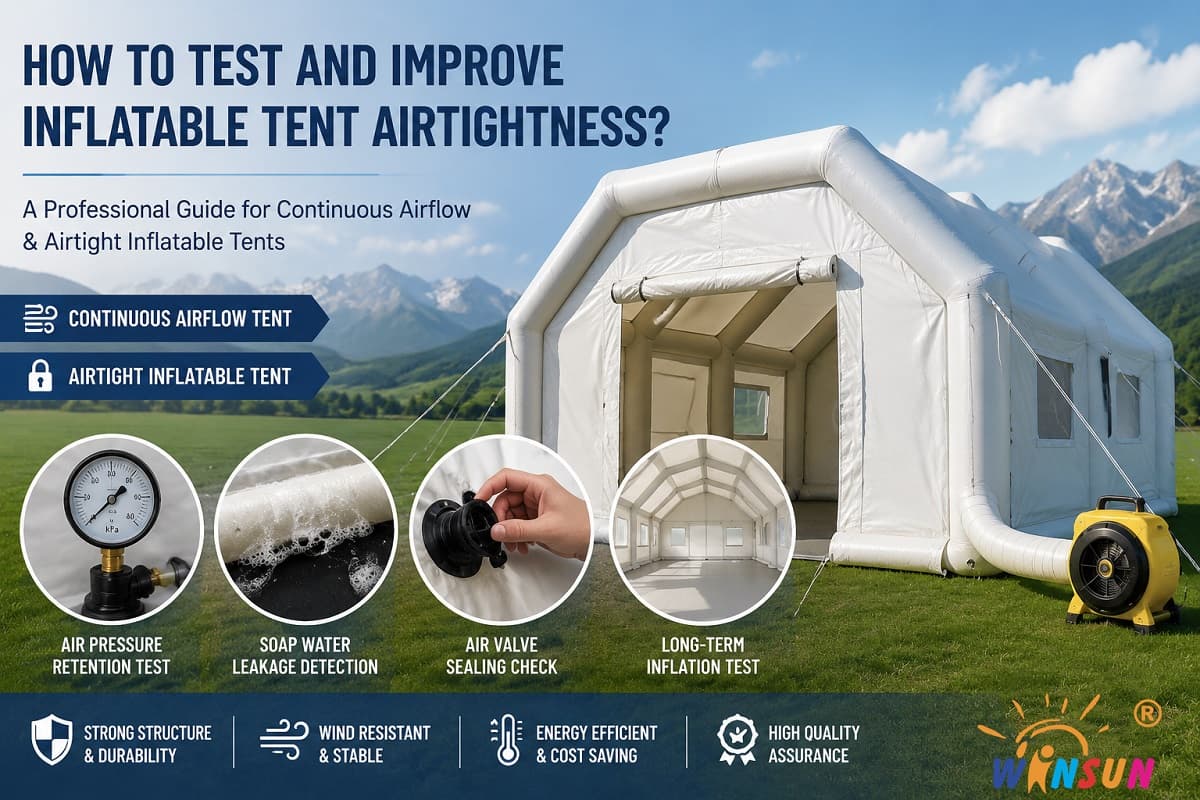
How to Test and Improve Inflatable Tent Airtightness? – A Professional Guide for Continuous Airflow & Airtight Inflatable Tents
Time:2026-07-07
Pageviews:0
Inflatable tents have become increasingly popular for outdoor events, emergency shelters, military applications, camping, exhibitions, and commercial activities due to their fast deployment, portability, and unique appearance. However, air tightness is one of the most important performance factors that determines the durability, safety, and user experience of an inflatable tent.
As a professional inflatable tent manufacturer, WINSUN specializes in producing commercial-grade inflatable tents made from reinforced PVC tarpaulin, including both continuous airflow inflatable tents and airtight sealed inflatable tents. Through advanced manufacturing processes, strict quality control, and professional testing methods, we ensure our inflatable structures maintain stable air pressure and long-term performance in different environments.
This article explains how inflatable tent airtightness is tested and what manufacturing methods can be used to improve air retention performance.
1. Why Inflatable Tent Airtightness Matters
The airtight performance of an inflatable tent directly affects:
✅ Structural Stability
An inflatable tent relies on internal air pressure to maintain its shape. Poor airtightness can cause:
- Reduced structural strength
- Deformation of inflatable beams or arches
- Unstable performance in windy conditions
- Shortened product lifespan
For large commercial inflatable tents, stable air pressure is essential to ensure the entire structure remains safe and functional.
✅ Energy Efficiency and Operating Cost
For continuous airflow inflatable tents, better airtightness means:
- Less air leakage
- Lower blower workload
- Reduced electricity consumption
- Longer blower service life
A well-designed inflatable tent can maintain proper pressure while minimizing unnecessary air loss.
✅ User Comfort
For airtight tents used as camping shelters, event spaces, or luxury glamping structures, good air retention helps maintain:
- Comfortable indoor temperature
- Reduced noise from air leakage
- Stable interior environment
2. Two Types of Inflatable Tent Air Systems
Before testing airtightness, it is important to understand the difference between the two main inflatable tent structures.
| Type |
Air System |
Material Requirement |
Airtightness Requirement |
| Continuous Airflow Inflatable Tent |
Powered by blower continuously |
Usually 0.55mm-0.6mm PVC tarpaulin |
Medium airtightness |
| Airtight Inflatable Tent |
Sealed air chamber, inflated once |
Usually 0.9mm PVC tarpaulin |
High airtightness |
Continuous Airflow Inflatable Tent
Continuous airflow tents use a blower system to continuously supply air pressure.
Characteristics:
- Easy inflation and deflation
- Suitable for large event structures
- Allows small air leakage during operation
- Requires reliable blower performance
Because air is continuously supplied, the fabric thickness is usually optimized between 0.55mm and 0.6mm PVC coated fabric, balancing durability, weight, and cost.
Airtight Inflatable Tent
Airtight tents use sealed air chambers that store pressure after inflation.
Characteristics:
- No continuous blower operation required
- Quiet operation
- Excellent portability
- Suitable for premium camping, exhibitions, and special applications
Due to higher requirements for air retention, airtight tents typically use thicker 0.9mm PVC tarpaulin with stronger airtight coating and reinforced seams.
3. Professional Inflatable Tent Airtightness Testing Methods
A professional inflatable tent manufacturer should perform multiple airtightness tests during production.
3.1 Air Pressure Retention Test
The most common method is measuring how long the inflatable structure can maintain internal pressure.
Testing Process:
- Inflate the tent to the designed working pressure
- Close all air valves and blower connections
- Record the initial pressure
- Monitor pressure changes over a specific period
- Evaluate air pressure loss rate
A high-quality airtight inflatable tent should maintain stable pressure with minimal loss.
3.2 Soap Water Leakage Detection
Soap water testing is widely used for locating small air leaks.
Process:
- Apply soap solution to suspected areas
- Observe whether bubbles appear
- Repair leaking points immediately
Common leakage locations include:
- Welding seams
- Air valves
- Connection areas
- Corners and stress points
This method is simple but effective for quality inspection.
3.3 Underwater Leakage Test for Small Components
For smaller inflatable parts, manufacturers may use underwater testing.
The component is inflated and placed underwater. Air bubbles indicate leakage points.
This method is commonly used for:
- Air valves
- Small inflatable accessories
- Repair testing
3.4 Long-Term Inflation Test
Before shipment, professional manufacturers should conduct extended inflation tests.
Typical inspection includes:
- Continuous inflation duration
- Pressure stability
- Seam performance
- Shape deformation
- Valve reliability
Long-term testing helps identify hidden manufacturing problems before products reach customers.
4. Key Factors Affecting Inflatable Tent Airtightness
4.1 PVC Tarpaulin Quality
The fabric is the foundation of airtight performance.
High-quality inflatable tent fabric should have:
- Strong airtight coating
- Uniform PVC layer
- High tensile strength
- Good flexibility
- UV resistance
- Cold resistance
WINSUN uses commercial-grade PVC coated tarpaulin designed specifically for inflatable applications.
4.2 Welding Technology
The quality of seams directly affects air retention.
Common joining methods include:
High-Frequency Welding (HF Welding)
Advantages:
- Strong molecular bonding
- Smooth and consistent seams
- Excellent airtight performance
Heat Welding
Advantages:
- Suitable for large PVC structures
- Strong and durable connections
Professional welding parameters must be controlled according to:
- Fabric thickness
- Temperature
- Welding pressure
- Welding speed
4.3 Seam Design and Reinforcement
Weak seam structures are one of the main causes of air leakage.
To improve performance:
- Increase seam width
- Add reinforcement layers at stress points
- Avoid excessive fabric tension
- Strengthen corners and connection areas
For large inflatable tents, reinforced stress zones are especially important.
4.4 Air Valve Quality
Air valves are critical components of inflatable tents.
High-quality valves should provide:
- Reliable sealing
- Easy operation
- Strong connection with fabric
- Long-term durability
Poor valve design can cause slow air leakage even when the fabric and seams are excellent.
5. How to Improve Inflatable Tent Airtightness
Manufacturers can improve airtightness through several approaches.
5.1 Select the Correct Material Thickness
Choosing the right PVC fabric thickness is essential.
Recommended applications:
| Application |
Recommended PVC Thickness |
| Continuous airflow inflatable tents |
0.55mm - 0.6mm PVC tarpaulin |
| Airtight sealed inflatable tents |
Around 0.9mm PVC tarpaulin |
Using unnecessarily thick materials can increase weight and cost without improving practical performance.
5.2 Optimize Manufacturing Process
Improvement methods include:
- Strict welding parameter control
- Multiple seam inspections
- Reinforced corner construction
- Professional air pressure testing
- Quality inspection before shipment
5.3 Improve Design Structure
Good inflatable tent design reduces stress on seams.
Design improvements include:
- Rounded corners instead of sharp angles
- Balanced air chamber structure
- Proper pressure distribution
- Reinforced connection points
5.4 Use Professional Repair and Maintenance Methods
Even high-quality inflatable tents require proper maintenance.
Recommended practices:
- Clean PVC fabric regularly
- Avoid sharp objects
- Store completely dry
- Repair small damage immediately
- Check valves and seams periodically
Early maintenance prevents small leaks from becoming major problems.
6. Quality Control Process at WINSUN Inflatable Tent Factory
As a professional inflatable product supplier, WINSUN follows a strict quality control process:
Material Inspection
✔ PVC thickness measurement
✔ Fabric surface inspection
✔ Coating quality check
Production Inspection
✔ Welding quality control
✔ Seam reinforcement inspection
✔ Component installation check
Finished Product Testing
✔ Inflation test
✔ Pressure retention test
✔ Air leakage inspection
✔ Final appearance inspection
Every inflatable tent is carefully tested before shipment to ensure reliable performance for commercial users worldwide.
7. Conclusion: Airtightness Determines Inflatable Tent Performance
A high-quality inflatable tent requires more than attractive design. Reliable airtightness is the foundation of safety, durability, and user satisfaction.
By selecting suitable PVC materials, improving welding technology, optimizing structural design, and performing strict air retention tests, manufacturers can significantly enhance inflatable tent performance.
Whether you need a continuous airflow inflatable event tent or a premium airtight inflatable camping structure, working with an experienced inflatable tent manufacturer ensures better quality, longer service life, and greater value.
WINSUN provides professional OEM/ODM inflatable tent solutions with commercial-grade PVC materials, advanced manufacturing technology, and strict quality control for customers worldwide.
Contact WINSUN for Expert Consultation
Email: info@winsuntent.com
Website: www.winsuntent.com