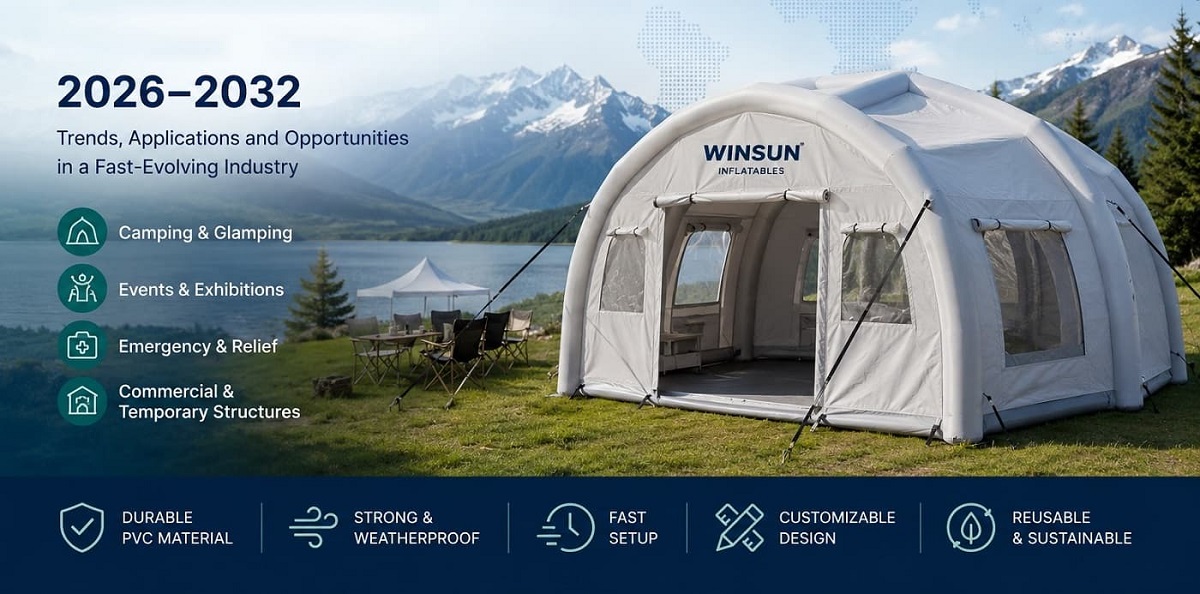
Global Inflatable Tent Market Trends 2026–2032
Time:2026-08-11
Pageviews:0
The global inflatable tent industry is entering an important period of development. As outdoor recreation, camping, glamping, events, exhibitions, and temporary commercial spaces continue to evolve, inflatable tents are becoming an increasingly versatile alternative to traditional pole and frame structures.
Unlike conventional tents that rely on rigid poles or metal frames, inflatable tents use air-supported structures to create stable and spacious shelters. This design offers advantages in portability, installation efficiency, visual appeal, and customization.
For professional manufacturers and buyers, the market between 2026 and 2032 will be shaped not simply by increasing demand for tents, but by changing expectations for durability, functionality, portability, customization, and commercial performance.
For manufacturers specializing in PVC-coated tarpaulin continuous-inflation and airtight inflatable tents, these changes create significant opportunities to develop more specialized and application-oriented products.
1. The Inflatable Tent Industry Is Expanding Beyond Camping
Inflatable tents were once primarily associated with outdoor recreation and camping.
Today, their applications are much broader.
Modern inflatable structures can be used for:
• Family camping
• Glamping
• Outdoor resorts
• Festivals
• Sports events
• Trade shows
• Exhibitions
• Brand promotions
• Corporate events
• Temporary commercial spaces
• Emergency shelters
• Field offices
• Temporary medical facilities
• Outdoor hospitality
This diversification is one of the most important trends shaping the industry.
Instead of being considered simply an alternative camping tent, inflatable tents are increasingly viewed as flexible temporary structures that can be adapted to different environments and applications.
2. Outdoor Recreation Continues to Drive Demand
Camping and outdoor recreation remain important applications for inflatable tents.
Modern consumers increasingly look for outdoor experiences that combine nature with convenience and comfort. This has encouraged manufacturers to develop larger and more functional inflatable tents with improved interior layouts.
Compared with traditional camping tents, inflatable designs can provide:
• Large interior spaces
• Flexible room layouts
• High ceilings
• Fast inflation
• Convenient packing
• Reduced dependence on rigid poles
• Attractive modern designs
• Customizable colors and graphics
For family camping and premium outdoor accommodation, these features can make inflatable tents particularly attractive.
3. Glamping Is Creating New Product Opportunities
Glamping has become an important direction within the outdoor accommodation industry.
Customers are increasingly looking for outdoor experiences that offer both natural surroundings and comfortable living conditions.
This creates opportunities for larger inflatable structures designed around comfort rather than simply minimum shelter requirements.
Potential features include:
• Separate sleeping areas
• Living spaces
• Large windows
• Multiple entrances
• Ventilation systems
• Private rooms
• Furniture areas
• Electrical access
• Lighting
• Custom interior layouts
For glamping operators, the tent can also become part of the visual identity of the property.
A distinctive inflatable structure can help an outdoor resort create a recognizable appearance while providing a flexible accommodation solution.
4. Commercial Events Are Becoming an Important Application
Another major trend is the use of inflatable tents for commercial events.
Event organizers often need temporary structures that can be transported, installed, removed, and reused efficiently.
Inflatable tents can be used for:
• Exhibition booths
• Trade shows
• Outdoor festivals
• Sports events
• Product launches
• Corporate events
• VIP areas
• Hospitality areas
• Ticketing areas
• Information centers
• Promotional installations
One of the key advantages is installation efficiency.
An inflatable structure can often be packed into a relatively compact package and transported between locations, making it attractive for businesses that operate across multiple events.
5. Branding and Customization Will Become More Important
As inflatable tents become more common in commercial applications, customization is becoming an increasingly important competitive advantage.
Commercial customers may require tents that match their brand identity, event theme, or specific operating requirements.
Customization can include:
• Tent dimensions
• Layout
• Number of rooms
• Doors
• Windows
• Air-beam configuration
• Colors
• Logos
• Digital printing
• Interior partitions
• Ventilation
• Accessories
• Packaging
• Private-label branding
Large inflatable surfaces also provide valuable space for graphics and promotional messages.
For businesses, an inflatable tent can therefore serve two purposes:
Shelter + Marketing
This makes customized inflatable tents particularly attractive for exhibitions, festivals, sports events, product promotions, and corporate activities.
6. PVC-Coated Tarpaulin for Commercial Inflatable Tents
Material selection is one of the most important factors in inflatable tent performance.
Different inflatable tents have different requirements, and lightweight recreational products should not necessarily be compared directly with commercial-grade structures.
For professional commercial inflatable tents, PVC-coated tarpaulin provides a strong combination of durability, waterproofing, abrasion resistance, cleanability, and printability.
Important advantages include:
Durability
PVC-coated tarpaulin is designed to withstand repeated handling, transportation, installation, and outdoor use.
Waterproof Performance
The coated surface provides reliable protection against rain and moisture when properly designed and manufactured.
Abrasion Resistance
Commercial tents may be repeatedly folded, transported, and installed. A durable outer material can help withstand this type of use.
Easy Maintenance
PVC-coated surfaces are relatively easy to clean, making them suitable for products that need to be reused frequently.
Custom Printing
PVC-coated tarpaulin provides a suitable surface for digital printing, allowing manufacturers to create customized colors, graphics, logos, and branding.
7. Continuous-Inflation and Airtight Inflatable Tents
One of the most important technical distinctions in the inflatable tent industry is the difference between continuous-inflation structures and airtight structures.
Continuous-Inflation Inflatable Tents
Continuous-inflation tents use an electric blower to maintain air pressure inside the inflatable structure.
Typical advantages include:
• Fast inflation
• Simple operation
• Efficient setup
• Suitable for larger structures
• Convenient for temporary installations
• Suitable for applications where continuous power is available
For professional continuous-inflation products, approximately 0.55–0.60 mm PVC-coated tarpaulin can provide a practical balance between durability, weight, and portability, depending on the product design.
Airtight Inflatable Tents
Airtight inflatable tents use sealed air chambers designed to retain air after inflation.
Typical advantages include:
• No continuous air supply during normal operation
• Lower operating noise
• Reduced dependence on continuous blower operation
• Convenient for longer deployments
• Suitable for applications where quiet operation is preferred
For commercial airtight inflatable structures, approximately 0.90 mm PVC-coated tarpaulin can provide a strong and durable construction, depending on the structural design and application.
The choice between these two systems should be based on the intended application, installation conditions, expected usage, and required operating characteristics.
8. Lightweight vs. Commercial-Duty Inflatable Tents
The industry is also moving toward more clearly differentiated product categories.
A lightweight recreational tent may prioritize:
• Low weight
• Easy transportation
• Simple setup
• Compact packing
A commercial inflatable tent may prioritize:
• Durability
• Repeated installation
• Structural stability
• Waterproof performance
• Heavy-duty materials
• Branding
• Long-term outdoor use
• Professional appearance
This means there is no single “best” inflatable tent material or construction method.
The appropriate solution depends on how the tent will be used.
For example, a frequently transported recreational tent may require a different material and structure from a large commercial event tent that is installed repeatedly throughout the year.
Professional manufacturers should therefore select materials according to the complete product design rather than simply using the thickest available material.
9. Product Design Is Moving Toward More Functional Spaces
Another important trend is the development of inflatable tents with more sophisticated interior layouts.
Instead of providing only one large open space, modern inflatable structures can incorporate multiple functional areas.
Possible configurations include:
• Bedrooms
• Living rooms
• Storage areas
• Reception areas
• Meeting spaces
• Exhibition zones
• Hospitality areas
• Separate entrances
• Internal partitions
This is particularly useful for glamping, commercial events, and temporary business facilities.
The ability to customize the internal layout allows manufacturers to serve customers with very different requirements without relying on a single standard product.
10. Modular Inflatable Structures
Modularity is another promising direction for inflatable tent design.
Instead of producing one extremely large structure, manufacturers can create systems that allow multiple inflatable units to work together.
For example:
Module A + Module B + Module C = Larger Temporary Space
This approach can provide greater flexibility for:
• Events
• Exhibitions
• Hospitality
• Outdoor venues
• Temporary offices
• Commercial activities
Modular systems can also make transportation and installation more manageable.
As customers become more familiar with inflatable structures, modular designs may become increasingly attractive for businesses that need adaptable temporary spaces.
11. Inflatable Tents for Temporary and Emergency Applications
Inflatable structures can also provide practical solutions where conventional buildings are unavailable or inconvenient.
Potential applications include:
• Temporary field offices
• Emergency command centers
• Temporary medical spaces
• Disaster response shelters
• Temporary storage
• Mobile service facilities
• Humanitarian operations
However, these applications require careful consideration of structural safety, fire performance, environmental conditions, applicable regulations, and engineering requirements.
Consumer camping products should not automatically be considered suitable for specialized emergency or medical applications.
For professional manufacturers, this creates an opportunity to develop application-specific structures rather than treating every inflatable tent as the same product category.
12. Sustainability and Product Life Cycle
Sustainability is becoming increasingly relevant to the outdoor products industry.
For inflatable tents, one important consideration is the relationship between product durability and product life cycle.
A durable tent that can be:
• Used repeatedly
• Repaired
• Maintained
• Transported
• Reinstalled
• Stored
• Reused for multiple seasons
can provide more long-term value than a product designed primarily for short-term use.
For commercial customers, durability is therefore not simply a quality feature. It can directly affect the total cost of ownership.
Manufacturers should focus on:
• Durable materials
• Reinforced stress points
• Reliable seams
• Replaceable components where practical
• Proper packaging
• Repair support
• Clear maintenance instructions
13. E-Commerce Is Changing How Customers Buy Inflatable Tents
The purchasing process for inflatable tents is also changing.
Customers can now research products online before contacting manufacturers.
They expect websites to provide clear information about:
• Product dimensions
• Materials
• Inflation systems
• Setup procedures
• Applications
• Product features
• Warranty
• Safety
• Customization
• Shipping
• Maintenance
High-quality product photography and installation videos are also becoming increasingly important.
For manufacturers, this means that a professional website is no longer simply a company introduction.
It is becoming an important part of the product education and sales process.
Customers should be able to understand the product before requesting a quotation.
14. OEM and ODM Services Will Become More Valuable
As applications become more specialized, standard products may not satisfy every commercial customer.
OEM and ODM capabilities allow manufacturers to provide solutions based on specific requirements.
A professional inflatable tent manufacturer may support customers with:
• Concept development
• Structural design
• Size customization
• Layout design
• Material selection
• Color customization
• Logo printing
• Functional accessories
• Packaging
• Production
• Quality inspection
This capability is particularly valuable for:
• Outdoor brands
• Camping companies
• Glamping operators
• Event companies
• Rental businesses
• Advertising agencies
• Distributors
• Importers
The ability to move from idea → design → prototype → production can become an important competitive advantage.
15. What Buyers Should Look for in an Inflatable Tent Manufacturer
As the market develops, buyers should look beyond the product price.
Important factors include:
Material Quality
Ask what type of PVC-coated tarpaulin is used and whether the material is appropriate for the intended application.
Construction Method
Understand whether the tent uses continuous inflation or airtight construction.
Reinforcement
Stress points, handles, connection areas, and anchoring points should receive appropriate reinforcement.
Seam Quality
Sewing or welding quality has a direct influence on long-term performance.
Air System
For continuous-inflation products, the blower and air-management system should be appropriate for the structure.
Design Capability
A professional supplier should be able to provide application-specific designs rather than simply offering standard models.
Quality Control
Production inspection should cover dimensions, appearance, seams, air systems, accessories, and packaging.
Warranty and Support
A clear warranty and after-sales process can reduce risks for commercial buyers.
OEM/ODM Capability
For businesses developing their own products, customization capability can be an important long-term advantage.
16. The Future of Inflatable Tents: 2026–2032
Looking toward 2032, several trends are likely to continue shaping the inflatable tent industry.
More Application-Specific Products
Instead of one product serving every customer, manufacturers will increasingly develop specialized structures for camping, glamping, events, exhibitions, sports, commercial use, and temporary facilities.
Greater Focus on Durability
Commercial customers will increasingly evaluate products according to their expected service life and total cost of ownership.
More Customization
Customized sizes, layouts, colors, graphics, and functions will become increasingly important.
Better Structural Design
Improvements in air-beam design, reinforcement, valves, connections, and overall structural engineering will continue to improve product performance.
More Professional Commercial Products
The market will continue moving beyond simple recreational tents toward larger and more sophisticated commercial inflatable structures.
Integration of Function and Branding
Inflatable tents will increasingly combine shelter, hospitality, exhibition, advertising, and brand presentation into a single structure.
17. WINSUN's Approach to Inflatable Tent Manufacturing
As a professional inflatable product manufacturer, WINSUN focuses on PVC-coated tarpaulin inflatable tents, including both continuous-inflation and airtight structures.
Our approach is based on selecting the appropriate material and construction method according to the intended application.
For continuous-inflation products, approximately 0.55–0.60 mm PVC-coated tarpaulin can provide an effective balance of durability, weight, and portability.
For airtight products, approximately 0.90 mm PVC-coated tarpaulin can provide a stronger construction for demanding commercial applications.
However, material thickness is only one part of a reliable inflatable tent.
Professional manufacturing also requires attention to:
• Structural design
• Reinforcement
• Seam construction
• Air-beam configuration
• Air valves
• Doors and windows
• Ventilation
• Digital printing
• Accessories
• Packaging
• Quality inspection
By combining appropriate materials with professional manufacturing processes, inflatable tents can be designed for different levels of performance and different commercial environments.
Conclusion
The inflatable tent industry is developing from a niche outdoor product category into a broader market for portable, reusable, customizable, and application-specific structures.
From 2026 to 2032, the most important opportunities are likely to come from the continued development of:
Camping + Glamping + Events + Exhibitions + Commercial Applications + Temporary Structures
At the same time, customers will increasingly expect more than simple portability.
They will look for:
Durability + Functionality + Easy Setup + Customization + Professional Manufacturing
PVC-coated tarpaulin will remain an important material for commercial inflatable tents because it offers a practical combination of durability, waterproofing, abrasion resistance, cleanability, and customization potential.
For manufacturers, the future is not simply about producing more inflatable tents.
It is about developing better-designed, application-specific inflatable structures that provide greater value throughout their entire product life cycle.
For buyers, choosing the right manufacturer will become increasingly important.
A reliable inflatable tent supplier should be able to provide not only a finished product, but also material expertise, structural design, customization, quality control, production capability, and long-term support.
As the industry continues to evolve toward 2032, these capabilities will help define the next generation of professional inflatable tents.
About WINSUN Tents:
WINSUN Tents combines 19+ years of PVC manufacturing expertise with innovative inflatable engineering to deliver premium temporary structures for clients worldwide. From advertising tents to emergency shelters, we build solutions that outperform expectations.
Consultation Inquiries:
Email: Info@winsuntent.com
Website: www.winsuntent.com