NEWS
About the company's industry news
POSITION: Home > News
Wind Resistance and Compression Performance Analysis of Inflatable Structure Tents
Time:2026-08-04
Pageviews:0
Share:
How PVC Tarpaulin Inflatable Tents Achieve Stability and Durability in Outdoor Environments

Inflatable structure tents have become an increasingly popular solution for outdoor accommodation, emergency shelters, commercial events, glamping projects, and recreational applications. Compared with traditional framed tents, inflatable tents use air-supported structures to create strong, lightweight, and flexible spaces without heavy metal frames.

As a professional inflatable tent manufacturer specializing in PVC tarpaulin continuous inflation tents and airtight closed-air inflatable tents, WINSUN focuses on structural design, material selection, air pressure control, and manufacturing technology to improve wind resistance and compression performance.

This article explains how inflatable tents withstand wind loads, external pressure, and harsh outdoor conditions.
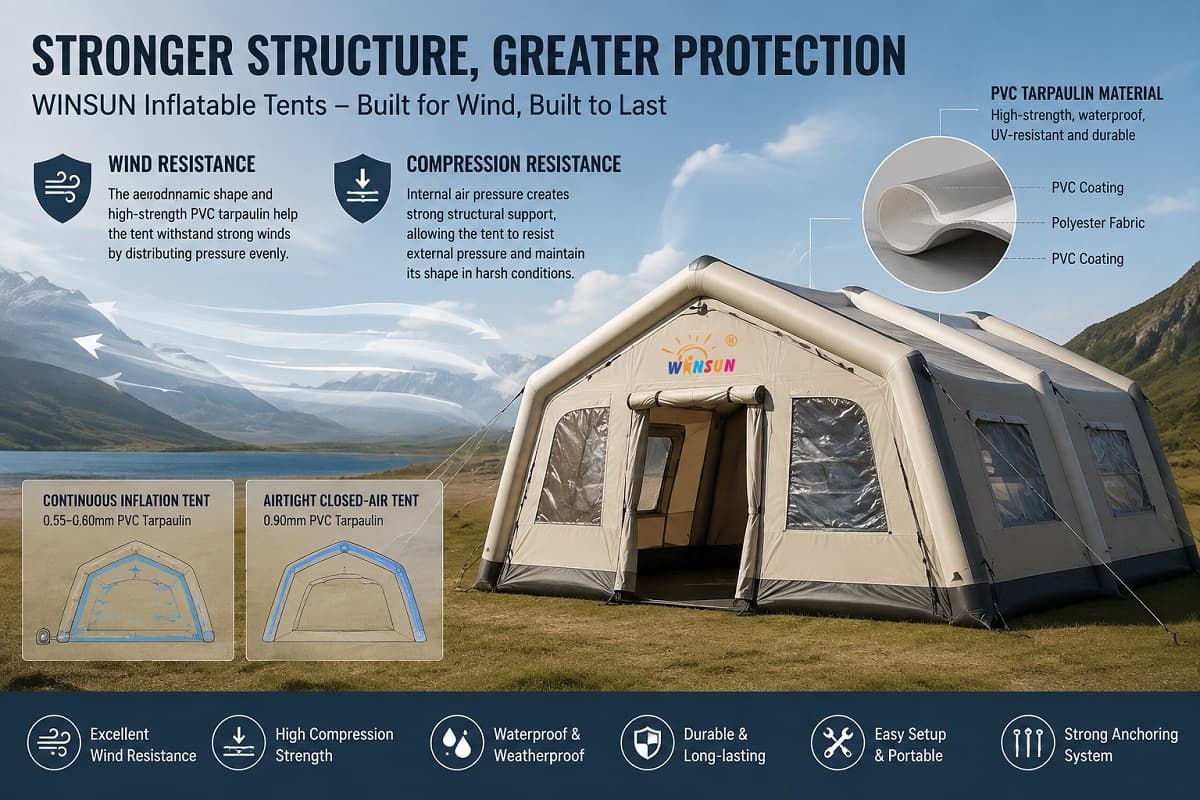


1. The Structural Principle Behind Inflatable Tent Stability

Unlike traditional tents that rely on rigid poles or metal frames, inflatable tents use pressurized air beams as the main supporting structure.

The air inside the inflatable tubes creates internal pressure, which provides structural strength and maintains the shape of the tent.

The basic principle is similar to an air-supported building:
• Internal air pressure creates tension within the fabric structure
• The flexible PVC tarpaulin transfers external forces across the whole structure
• Curved air beams distribute wind pressure more evenly
• The lightweight structure can absorb temporary deformation and return to its original shape

This flexibility is one of the biggest advantages of inflatable structures.

When strong wind pushes against the tent, the structure can slightly deform instead of resisting the force as a rigid structure would. This reduces concentrated stress points and improves overall stability.


2. Continuous Inflation Tent vs Airtight Closed-Air Tent: Wind Resistance Comparison

Inflatable tents can generally be divided into two structural types:
1. Continuous Inflation Inflatable Tents
2. Airtight Closed-Air Inflatable Tents

Each design has different performance characteristics.

Feature Continuous Inflation Tent Airtight Closed-Air Tent
Air System Air blower continuously supplies air Inflated once and maintains internal pressure
Material Thickness 0.55–0.60mm PVC tarpaulin 0.90mm PVC tarpaulin
Air Pressure Lower internal pressure Higher internal pressure
Structure Support Flexible air beams High-pressure sealed air tubes
Wind Resistance Excellent with continuous airflow Excellent with stronger tube rigidity
Maintenance Requires continuous blower operation No continuous power required
Application Events, outdoor activities, commercial use Camping, expedition, premium outdoor shelters

Both structures can provide excellent wind resistance when properly designed, manufactured, anchored, and operated.


3. The Role of PVC Tarpaulin Material in Wind Resistance

The performance of an inflatable tent depends greatly on the quality of the outer fabric.

WINSUN inflatable tents use PVC tarpaulin (PVC coated polyester fabric), which combines:
• High tensile strength polyester base fabric
• Waterproof PVC coating
• UV resistance
• Abrasion resistance
• Tear resistance
• Weather durability

The PVC tarpaulin acts as the "skin" of the inflatable structure, containing internal air pressure while transferring external forces throughout the tent body.

Recommended Material Thickness

Application Recommended PVC Tarpaulin Thickness Characteristics
Continuous Inflation Tent 0.55–0.60mm PVC Tarpaulin Lightweight, flexible, durable for long-time inflation
Airtight Closed-Air Tent 0.90mm PVC Tarpaulin Higher strength, better pressure retention and durability

A thicker material does not always mean better performance. The correct balance between flexibility, weight, air pressure, and structural design is more important.


4. How Inflatable Tents Resist Wind Forces

Wind resistance is determined by multiple factors, including:

4.1 Air Beam Design
The shape and arrangement of inflatable tubes directly affect stability.

Professional inflatable tent designs usually include:
• Multiple interconnected air beams
• Reinforced tube intersections
• Symmetrical structural layouts
• Rounded aerodynamic shapes

Compared with flat-wall structures, curved inflatable designs reduce wind impact because airflow can move around the surface more smoothly.

4.2 Internal Air Pressure
Air pressure is the "hidden support system" of an inflatable tent.

Higher internal pressure creates:
• Stronger air beams
• Better shape retention
• Higher resistance against external compression

For airtight tents, sealed air tubes maintain constant pressure after inflation, creating a rigid and stable supporting frame.

For continuous inflation tents, the blower continuously compensates for air leakage through seams and material permeability, keeping the structure stable during operation.

4.3 Proper Ground Anchoring System
Even a strong inflatable structure requires proper anchoring.

Wind resistance depends not only on the tent itself but also on:
• Ground conditions
• Anchor quantity
• Anchor positioning
• Rope tension
• Installation method

Professional inflatable tent installation normally includes:
• Heavy-duty anchor points
• Reinforced D-rings
• Strong ropes or straps
• Proper tension adjustment

The anchoring system transfers wind loads from the tent structure to the ground.


5. Compression Resistance of Inflatable Tent Structures

Many people assume inflatable structures are soft and cannot withstand pressure. In reality, properly designed inflatable structures have excellent compression performance.

The reason is that compressed air provides internal support.

When external pressure is applied:
1. The outer PVC fabric receives the force
2. The air inside the tube distributes the pressure
3. The entire structure shares the load
4. The inflatable beam returns to its original shape after pressure is removed

This makes inflatable tents resistant to:
• Temporary wind pressure
• External pushing forces
• Snow or rain accumulation (within design limits)
• Transportation and handling stress


6. Manufacturing Details That Improve Structural Strength

High-quality inflatable tents require more than good materials. Manufacturing technology plays a critical role.

WINSUN inflatable tents use:

Reinforced Sewing Technology
For continuous inflation tents:
• Double stitching at stress areas
• Reinforced seams
• Strong thread selection
• Increased load-bearing areas

These details improve long-term durability under continuous air pressure.

Heat Welding Technology
For airtight closed-air tents:
• High-frequency welding or heat welding creates strong airtight seams
• Prevents air leakage
• Improves pressure retention
• Enhances structural rigidity

Reinforced Connection Points
The areas where air tubes connect receive the highest stress.

Professional designs reinforce:
• Tube intersections
• Door areas
• Anchor points
• High-tension fabric sections


7. What Wind Speed Can an Inflatable Tent Handle?

The actual wind resistance depends on:
• Tent size
• Structure design
• Material thickness
• Inflation pressure
• Anchoring system
• Installation environment

There is no universal wind-speed rating for all inflatable tents.

A properly designed commercial inflatable tent with professional anchoring can withstand strong outdoor wind conditions. However:
• Temporary event tents should be monitored during extreme weather
• Operators should follow safety guidelines
• The tent should not be used during severe storms or hurricanes unless specifically designed and certified for such conditions

Safety always depends on correct installation and operation.


8. Why Choose WINSUN Inflatable Structure Tents?

As an experienced inflatable product manufacturer, WINSUN combines:

Professional Material Selection
High-quality PVC tarpaulin designed for outdoor durability.

Advanced Manufacturing
Experienced production teams with strict quality control.

Structural Design Experience
Optimized air beam layouts for stability and efficiency.

Custom Solutions
Different sizes, shapes, colors, and functions available for commercial and private applications.

Global Application Experience
Inflatable tents supplied for:
• Outdoor camping
• Glamping resorts
• Emergency shelters
• Military and rescue applications
• Events and exhibitions
• Outdoor entertainment projects


Conclusion: A Strong Balance Between Flexibility and Strength

Inflatable structure tents achieve excellent wind resistance and compression performance through the combination of:
• High-strength PVC tarpaulin
• Proper internal air pressure
• Aerodynamic structural design
• Reinforced manufacturing technology
• Professional anchoring systems

Compared with traditional framed structures, inflatable tents provide a unique advantage: lightweight flexibility with reliable structural strength.

For customers looking for durable outdoor shelters, commercial inflatable camping tents, or customized inflatable structures, choosing a professional manufacturer with proven material and structural expertise is essential.

WINSUN inflatable tents are designed to deliver safety, durability, and performance in real outdoor environments.


About WINSUN Tents:
WINSUN Tents combines 19+ years of PVC manufacturing expertise with innovative inflatable engineering to deliver premium temporary structures for clients worldwide. From advertising tents to emergency shelters, we build solutions that outperform expectations.

Consultation Inquiries:
Email: Info@winsuntent.com
Website: www.winsuntent.com