NEWS
About the company's industry news
POSITION: Home > News
Common Inflatable Tent Problems: Troubleshooting & Expert Solutions | WINSUN Tents
Time:2026-08-25
Pageviews:0
Share:
Pingdingshan, China – [August 25, 2026] — Inflatable tents are designed to provide fast setup, flexible layouts, and reliable protection for camping, events, exhibitions, emergency shelters, and outdoor commercial applications. However, like any professional equipment, an inflatable tent may occasionally experience problems related to inflation, air pressure, fabric, valves, seams, or operating conditions.
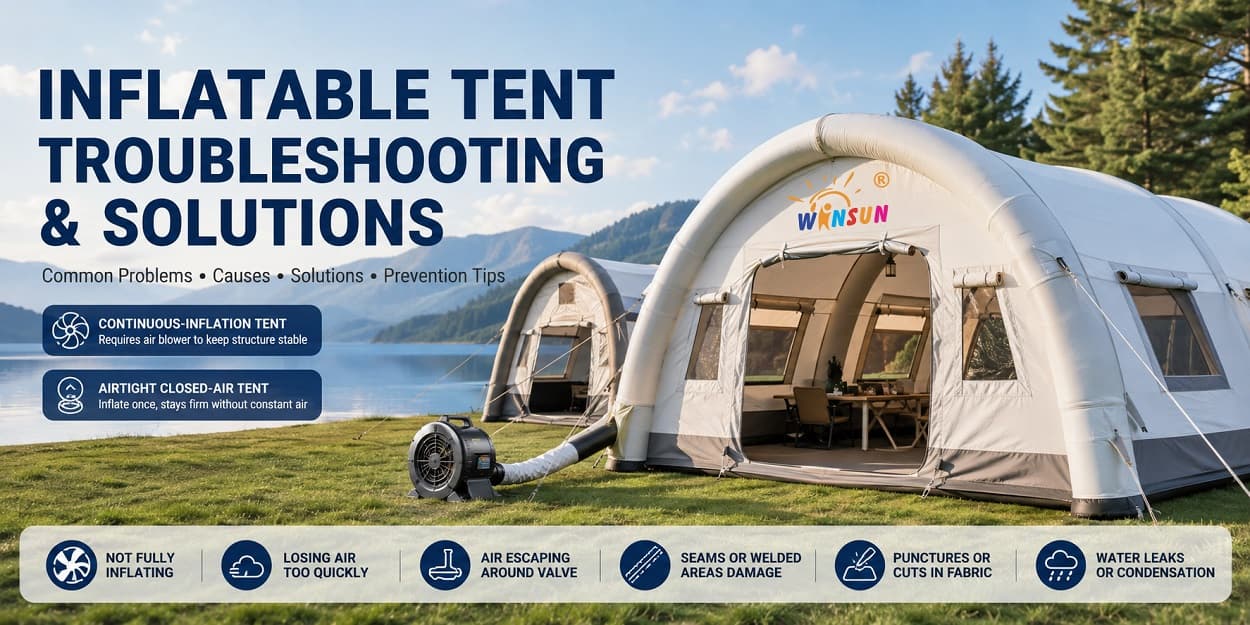
As a professional inflatable tent manufacturer and supplier, WINSUN produces both continuous-inflation tents and airtight closed-air tents using durable PVC-coated tarpaulin materials. Understanding the differences between these two systems is essential for proper troubleshooting.

This guide explains the most common inflatable tent problems, their possible causes, and practical solutions.

1. The Inflatable Tent Is Not Fully Inflating

Possible Causes
If the tent appears soft, uneven, or does not reach its normal shape, several factors may be responsible:
• The air blower is not operating correctly.
• The blower is not powerful enough for the tent.
• The inflation tube is partially blocked or bent.
• An air inlet or zipper is not properly closed.
• The tent has a leak.
• The tent is being operated under unusually low temperatures or other extreme conditions.

Solutions
First, check that the blower is correctly connected to the inflation tube and that the power supply is stable.

Then inspect the inflation tube for:
• Kinks or folds
• Blockages
• Loose connections
• Damaged fabric

Make sure all unused inflation openings, zippers, and air outlets are properly closed.

For a continuous-inflation tent, some air loss is normal because the blower continuously supplies air. The tent should become firm and maintain its intended shape while the blower is running.

For an airtight tent, the blower is normally used only during initial inflation. If the tent cannot maintain its shape after inflation, a leak or valve problem should be investigated.

2. The Tent Loses Air Too Quickly

Air loss is one of the most common concerns with inflatable products, but the correct troubleshooting method depends on the tent type.

Continuous-Inflation Tent
A continuous-inflation tent is designed to allow a controlled amount of air to escape through the structure while the blower continuously replaces it.

Therefore, small amounts of air leakage do not necessarily indicate a product failure.

Check:
1. Whether the blower is operating continuously.
2. Whether the blower has sufficient airflow.
3. Whether the inflation tube is properly connected.
4. Whether there are unusually large tears, punctures, or seam failures.

Airtight Closed-Air Tent
Airtight tents should retain air for an extended period after inflation.

If the pressure drops noticeably within a short time:
• Check the inflation valve.
• Check the valve cap or sealing mechanism.
• Inspect seams and welded areas.
• Check the fabric for punctures or cuts.
• Listen for escaping air around connection points.

A simple leak test can be performed using soapy water. Apply a small amount around suspicious areas and look for continuously forming bubbles.

3. The Blower Is Running but the Tent Still Feels Soft

If the blower is working but the tent does not become sufficiently firm, do not immediately assume that the tent fabric is defective.

Check the Following

1. Blower capacity
The blower must provide sufficient airflow for the specific tent design. Large commercial inflatable tents require appropriate airflow based on their size and internal structure.

2. Air connection
Check whether the inflation tube is fully attached to the blower outlet.

3. Air tube condition
A folded or compressed inflation tube can significantly restrict airflow.

4. Air leakage
Inspect the tent for large punctures, open zippers, loose valves, or damaged seams.

5. Electrical supply
An unstable power supply or unsuitable extension cable can affect blower performance.

Recommended Approach
Troubleshoot the system in this order:

Power supply → Blower → Inflation tube → Air inlet → Tent structure → Possible leakage

This helps identify the problem without unnecessarily disassembling the tent.

4. The Blower Becomes Hot During Operation

Inflatable tent blowers can become warm during continuous operation. However, excessive heat should not be ignored.

Possible Causes
• Insufficient ventilation around the blower
• Dust or debris blocking the air intake
• Incorrect electrical voltage
• Overloaded extension cable
• Blower operating beyond its recommended conditions
• Motor or electrical component problems

Solutions
Place the blower in a clean, dry, and well-ventilated area.

Keep the blower air inlet unobstructed and regularly remove dust and debris.

Always use the electrical voltage specified for the blower.

If the blower becomes excessively hot, produces unusual sounds, smells like burning, or repeatedly shuts down, stop using it and have it inspected by a qualified technician.

Never cover the blower during operation.

5. Air Is Escaping Around the Valve

For airtight inflatable tents, valves are critical to maintaining internal pressure.

Possible Causes
• Valve cap is not fully closed.
• Valve connection is loose.
• Valve seal is damaged.
• Dirt or debris is preventing proper sealing.
• Valve area has been damaged by excessive force.

Solutions
Remove the valve cap and inspect the sealing surface.

Clean away dust or debris and reinstall the valve cap correctly.

If air continues to escape, inspect the valve and surrounding fabric. A damaged valve may need professional replacement.

Avoid pulling, twisting, or stepping on valves during transportation and installation.

6. Small Punctures or Cuts in PVC Tarpaulin

Even durable PVC-coated tarpaulin can be punctured by sharp objects.

Common causes include:
• Sharp stones or branches
• Metal edges
• Improper handling
• Dragging the tent across rough ground
• Contact with sharp equipment
• Incorrect storage

How to Repair a Small Puncture

For a small puncture in PVC tarpaulin:

1. Deflate and clean the damaged area.
2. Allow the surface to dry completely.
3. Identify the full damaged area.
4. Use a suitable PVC repair patch.
5. Apply the repair material according to the manufacturer's instructions.
6. Allow the repair to cure completely before reinflating.

For larger cuts, damaged load-bearing areas, or structural seams, professional repair is recommended.

Do not use ordinary household tape as a permanent repair.

7. Seams or Welded Areas Show Damage

The seams of an inflatable tent are important structural areas and should be inspected regularly.

Possible Causes
• Excessive mechanical stress
• Improper folding
• Sharp-object damage
• Long-term abrasion
• Incorrect repair
• Extreme operating conditions

For sewn continuous-inflation tents, inspect the stitching and reinforced areas.

For airtight closed-air tents, inspect heat-welded seams and connection areas.

If a structural seam begins to separate, stop using the tent until the damage has been assessed and repaired.

8. The Tent Becomes Less Stable Outdoors

An inflatable tent can be correctly inflated and still become unstable if it is not properly secured.

Common Causes
• Insufficient anchoring
• Strong wind
• Incorrect anchoring points
• Uneven ground
• Incorrect installation
• Excessive movement around the tent

Solutions
Always install the tent on a suitable surface and use the recommended anchoring system.

Depending on the application, anchoring may include:
• Ground stakes
• Ropes
• Straps
• Sandbags or appropriate ballast systems
• Other engineered anchoring solutions

The anchoring method should be selected according to the tent size, location, surface conditions, and expected weather.

Do not operate an inflatable tent in weather conditions that exceed its specified operating limits.

9. The Tent Has Uneven or Distorted Sections

Sometimes an inflatable tent may look uneven even though there is no actual product failure.

Possible Causes
• Incorrect inflation
• Folded air tubes
• Insufficient internal pressure
• Incorrect installation
• The tent is positioned on uneven ground
• Internal partitions or connections are not correctly positioned

Solutions
Fully deflate the tent and reposition it on a suitable surface if necessary.

Make sure the main structure is correctly unfolded before inflation.

Check the air tubes and internal connections for folds or blockages.

Then reinflate the tent and observe whether the structure returns to its intended shape.

10. The Tent Becomes Soft in Cold Weather

Temperature can affect air pressure.

When the surrounding temperature decreases, the air inside the inflatable structure contracts, which can make the tent appear softer.

This does not necessarily mean that the tent has developed a leak.

What to Do
• Check the actual air pressure or firmness.
• Inspect the tent for leakage if the pressure loss is unusually large.
• Avoid overinflating simply because the tent feels softer in cold conditions.
• Follow the manufacturer's recommended operating pressure.

When the temperature rises again, the internal air pressure may increase.

11. The Tent Becomes Too Firm in Hot Weather

The opposite can happen in high temperatures.

As the air inside the inflatable structure heats up, internal pressure can increase.

Important Considerations
Avoid deliberately overinflating the tent to compensate for other problems.

Keep the tent away from unnecessary heat sources.

Follow the manufacturer's operating recommendations.

For airtight tents especially, monitor pressure changes when the tent is exposed to strong sunlight for extended periods.

12. Water Appears Inside the Tent

Water inside an inflatable tent does not always mean the PVC tarpaulin itself is leaking.

Possible Causes
• Condensation
• Rain entering through an open door or zipper
• Improperly closed openings
• Damaged fabric
• Damaged seams
• Water accumulation around the installation area

Solutions
Check doors, windows, zippers, and ventilation openings.

Inspect the tent after rain and identify the exact location where water is entering.

If water is entering through a damaged area of the PVC tarpaulin or seam, repair the affected section before the next use.

Condensation
Condensation can occur when warm, humid air comes into contact with a cooler tent surface.

Good ventilation can help reduce condensation, particularly during camping or overnight use.

13. The Tent Is Difficult to Deflate

A tent that does not deflate easily may have trapped air in internal chambers or restricted air outlets.

Possible Causes
• Deflation valves are not fully open.
• Zippers or openings remain closed.
• Air tubes are folded.
• The tent has not been laid flat.
• Internal air has become trapped.

Solutions
Open the appropriate deflation valves and air outlets.

Lay the tent flat and gradually push air toward the openings.

For large tents, several people may be needed to fold and compress the structure systematically.

Avoid dragging or aggressively forcing the folded tent, as this can damage the fabric and seams.

14. The Tent Has an Unusual Smell

A new PVC tarpaulin product may have a noticeable material odor when first unpacked.

This odor can normally decrease with ventilation and use.

However, a strong burning or electrical smell from the blower is different.

If the Smell Comes From the Tent
• Open the tent in a well-ventilated area.
• Allow it to air out before extended use.
• Keep the product away from open flames and high-temperature sources.

If the Smell Comes From the Blower
Stop operation immediately if there is a burning smell or abnormal electrical odor and inspect the blower system.

15. Blower Stops Suddenly

If a blower suddenly stops, check the following:

Electrical System
• Power connection
• Plug
• Extension cable
• Circuit breaker
• Voltage compatibility

Blower
• Air intake blockage
• Excessive dust
• Motor overheating
• Unusual noise
• Internal electrical fault

If the blower repeatedly stops after restarting, do not continue operating it without identifying the cause.

Continuous-Inflation vs. Airtight Tent Troubleshooting

One of the most important points is understanding that continuous-inflation and airtight inflatable tents work differently.

Problem Continuous-Inflation Tent Airtight Closed-Air Tent
Blower operation Continuous Mainly used for initial inflation
Normal air loss Some air loss is expected Very low air loss expected
Pressure maintenance Maintained by continuous airflow Maintained by airtight construction
Main components to check Blower, air tube, openings Valves, seams, fabric
Leak diagnosis Focus on abnormal air loss Important when pressure drops
Typical material 0.55–0.60 mm PVC tarpaulin Up to approximately 0.90 mm PVC tarpaulin
Common failure Blower/airflow issue Valve, seam or puncture issue

Understanding this difference prevents many unnecessary repairs.

How to Prevent Inflatable Tent Problems

Proper maintenance is often more effective than repairing problems after they occur.

Before Every Use
• Inspect the PVC tarpaulin.
• Check seams and reinforced areas.
• Check valves and inflation tubes.
• Inspect the blower and power cable.
• Check the ground for sharp objects.
• Confirm that all anchoring equipment is available.
• Check the weather conditions.

During Use
• Keep the blower protected from water and debris.
• Do not place heavy objects against the tent walls.
• Prevent sharp objects from contacting the fabric.
• Monitor the tent structure and anchoring system.
• Do not exceed recommended operating conditions.

After Use
• Clean dirt and debris from the tent.
• Allow the tent to dry completely.
• Inspect for damage.
• Deflate and fold it properly.
• Store it in a dry, cool location.
• Avoid prolonged exposure to direct sunlight during storage.

When Should You Contact the Manufacturer?

Some problems can be repaired easily with basic maintenance, while others require professional assistance.

Contact the manufacturer or a qualified repair professional when you find:

• Large cuts or tears
• Major seam separation
• Damaged structural components
• Damaged valves
• Repeated pressure loss in an airtight tent
• Serious blower or electrical problems
• Damage around major reinforced or load-bearing areas
• Unexplained deformation of the inflatable structure

For commercial inflatable tents, professional repair is generally preferable to improvised repairs that could affect structural performance.

Final Thoughts

Most inflatable tent problems can be prevented or resolved through proper installation, regular inspection, correct inflation, and appropriate storage.

The key is to first identify what type of inflatable tent you are using.

For continuous-inflation tents, troubleshooting should focus primarily on the blower, airflow system, inflation tubes, and abnormal leakage.

For airtight closed-air tents, troubleshooting should focus more on valves, seams, punctures, and pressure retention.

At WINSUN, we manufacture professional inflatable tents using durable PVC-coated tarpaulin, with options for both continuous-inflation and airtight designs. Our production process, reinforced construction, and customization capabilities allow us to develop inflatable tent solutions for camping, events, exhibitions, commercial applications, emergency use, and other specialized projects.

If you are experiencing a specific inflatable tent problem, providing photos or videos of the affected area, the tent type, dimensions, and operating conditions can help the manufacturer identify the likely cause and recommend the appropriate solution.


About WINSUN Tents:
WINSUN Tents combines 19+ years of PVC manufacturing expertise with innovative inflatable engineering to deliver premium temporary structures for clients worldwide. From advertising tents to emergency shelters, we build solutions that outperform expectations.

Consultation Inquiries:
Email: Info@winsuntent.com
Website: www.winsuntent.com