When choosing an inflatable tent, most buyers focus on appearance, size, waterproof performance, or price. However, the manufacturing process behind the tent is just as important.
The way an inflatable tent is constructed directly affects its air retention, durability, waterproof performance, structural stability, service life, and maintenance requirements.
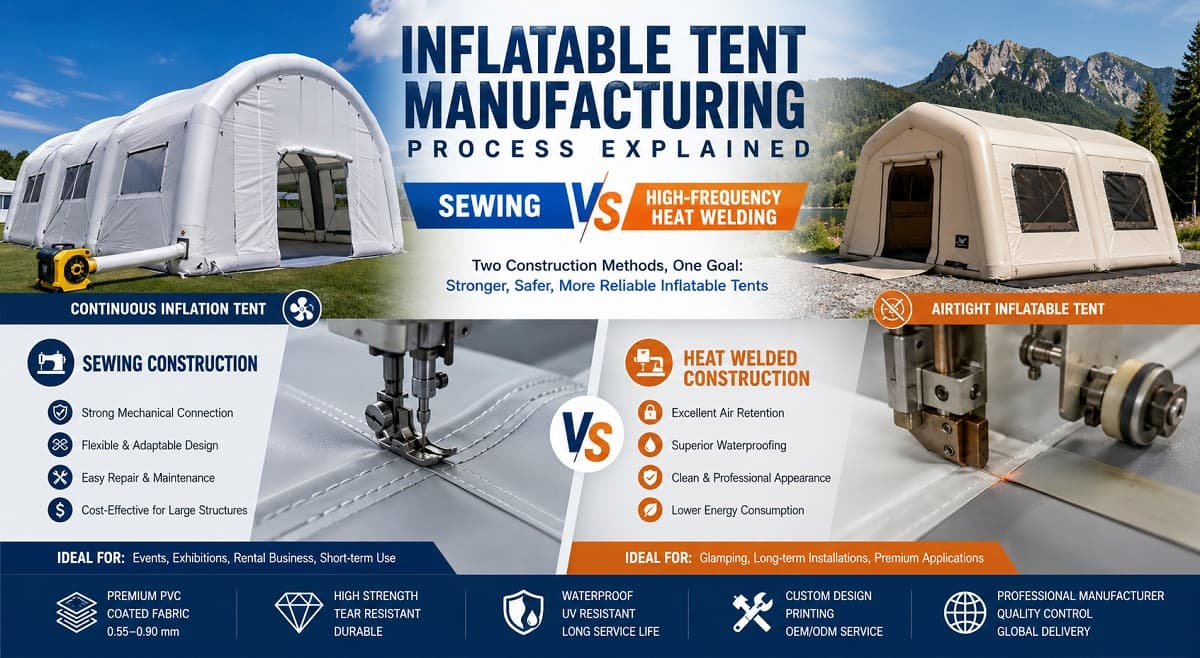
For professional inflatable tent manufacturers, two primary construction methods are widely used:
• Sewing construction for continuous-inflation inflatable tents
• High-frequency heat welding / thermal welding for airtight inflatable tents
Both methods can produce reliable commercial inflatable tents when properly designed and manufactured. The key is choosing the right construction method for the intended application.
As a professional inflatable tent manufacturer, WINSUN specializes in PVC-coated fabric / PVC tarpaulin inflatable tents, including both continuous-inflation and airtight designs. This guide explains how each manufacturing process works, their advantages and limitations, and how to determine which construction is best for your project.
1. What Materials Are Used to Manufacture Inflatable Tents?
Before discussing sewing and welding, it is important to understand the material used in professional inflatable tent production.
Commercial inflatable tents are commonly manufactured from PVC-coated fabric or PVC tarpaulin, which combines a strong textile base with PVC coatings.
This structure provides several important characteristics:
• High tensile strength
• Good tear resistance
• Waterproof performance
• Abrasion resistance
• Easy cleaning and maintenance
• Good resistance to outdoor conditions
• Suitable flexibility for folding and transportation
• Excellent compatibility with digital printing and custom graphics
For inflatable tent applications, material thickness is selected according to the construction method and product requirements.
Typical Material Selection
| Tent Construction |
Typical Material Thickness |
Main Application |
| Continuous Inflation |
0.55–0.60 mm |
Event tents, camping tents, temporary shelters |
| Airtight / Sealed Air |
Up to 0.90 mm |
Premium tents, long-duration installations, specialized structures |
At WINSUN, we mainly use 0.55–0.60 mm PVC-coated fabric for continuous-inflation products and up to 0.90 mm PVC material for airtight products.
The material itself is only one part of the equation. The construction process determines how individual fabric panels become a complete inflatable structure.
2. How Is an Inflatable Tent Manufactured?
Although the exact workflow varies according to product design, professional inflatable tent manufacturing normally includes several major stages:
Step 1: Product Design
The manufacturing process begins with a detailed structural design.
Engineers determine:
• Overall dimensions
• Shape and appearance
• Air chamber structure
• Entrance and exit design
• Window and ventilation locations
• Internal partitions
• Reinforcement areas
• Anchor points
• Air inlet and outlet positions
• Door and zipper systems
• Printing and branding areas
For large commercial tents, the structural design is particularly important because the inflatable frame must distribute loads evenly after inflation.
Step 2: Computerized Pattern Development
The three-dimensional tent structure is converted into individual two-dimensional fabric panels.
The pattern must account for:
• Material thickness
• Fabric stretch
• Connection points
• Seam allowances
• Inflation pressure
• Reinforcement requirements
• Final assembled dimensions
Poor pattern design can lead to uneven inflation, deformation, excessive stress, or unnecessary material consumption.
Step 3: Material Cutting
PVC-coated fabric is cut according to the production drawings.
Professional manufacturers use accurate cutting methods to maintain consistent dimensions between panels.
For customized inflatable tents, every component may have a different shape, including:
• Main structural panels
• Roof sections
• Sidewalls
• Air tubes
• Doors
• Windows
• Reinforcement patches
• Connection sections
Accurate cutting is essential because even small dimensional errors can accumulate during final assembly.
Step 4: Printing and Decoration
If the tent includes logos, patterns, advertising graphics, or custom branding, the artwork is applied before final assembly whenever possible.
Digital printing allows manufacturers to create:
• Company logos
• Advertising graphics
• Event branding
• Custom colors
• Themed designs
• Full-color patterns
The printing process must be compatible with the PVC-coated fabric and outdoor application.
Step 5: Structural Reinforcement
High-stress areas require additional reinforcement.
Typical reinforcement locations include:
• Anchor points
• Air inlet areas
• Handles
• Connection points
• Doors
• Zipper areas
• Structural intersections
• Areas exposed to repeated folding
Reinforcement may use additional PVC fabric, webbing straps, stainless-steel rings, or other structural components depending on the design.
Step 6: Main Assembly
This is where the manufacturing methods begin to differ significantly.
Continuous-inflation tents are primarily assembled through industrial sewing, while airtight tents require heat welding to create sealed air chambers.
Let's examine both processes in detail.
3. Sewing Construction for Continuous-Inflation Tents
Sewing is one of the most widely used construction methods for inflatable tents that operate with a continuous air supply.
In this type of product, an electric blower continuously supplies air to the inflatable structure.
Because air is continuously being replenished, the seams do not need to form a completely airtight pressure vessel.
Instead, the objective is to create a strong, durable and controlled airflow structure.
4. How Is a Sewn Inflatable Tent Made?
The basic sewing process includes several stages.
4.1 Panel Alignment
The cut PVC-coated fabric panels are positioned and aligned according to the production drawings.
Accurate alignment is important because the final tent shape depends on the relationship between dozens or even hundreds of individual fabric pieces.
4.2 Industrial Sewing
Heavy-duty industrial sewing machines are used to join the fabric panels.
Depending on the design, manufacturers may use:
• Single stitching
• Double stitching
• Reinforced stitching
• Webbing reinforcement
• Multiple seam layers
For commercial inflatable tents, important structural seams should not rely on a single lightweight stitch line.
4.3 Seam Reinforcement
High-stress seams may receive additional layers of PVC fabric or webbing.
This is especially important around:
• Anchor points
• Structural corners
• Air tubes
• Handles
• Door openings
• Connection points
The reinforcement distributes stress over a larger area instead of concentrating it on one stitching line.
4.4 Airflow and Blower Installation
A continuous-inflation tent normally includes one or more air inlets connected to electric blowers.
The blower continuously supplies air while the tent is in operation.
This means the tent is designed around controlled air leakage rather than complete airtightness.
5. Advantages of Sewing Construction
Sewn construction offers several important advantages for continuous-inflation inflatable tents.
Strong Mechanical Connections
Industrial sewing creates a mechanical connection between fabric layers.
When correctly designed and reinforced, sewn seams can provide excellent resistance to pulling and repeated folding.
Flexible Manufacturing
Sewing is highly adaptable to different tent shapes and configurations.
Manufacturers can relatively easily produce:
• Complex shapes
• Large tent structures
• Doors and windows
• Decorative elements
• Custom partitions
• Special connection systems
Efficient for Large Structures
For many commercial inflatable tents, sewing provides an efficient balance between production speed, durability and manufacturing cost.
Easier Repair
One major advantage of sewn construction is repairability.
If a seam is damaged, the affected section can often be repaired by:
1. Removing the damaged area
2. Repositioning the fabric
3. Re-sewing the seam
4. Adding reinforcement if required
This can be particularly useful for rental companies and event operators.
6. Limitations of Sewing Construction
Sewn inflatable tents are not completely airtight.
This is not necessarily a disadvantage because continuous-inflation tents are specifically designed to operate with a blower running continuously.
However, sewing is generally not the preferred method when a structure must retain air for a long period after the blower is switched off.
For those applications, an airtight construction method is more appropriate.
7. High-Frequency Heat Welding for Airtight Inflatable Tents
Airtight inflatable tents use a fundamentally different manufacturing approach.
Instead of stitching fabric panels together, compatible PVC surfaces are bonded using controlled heat and pressure.
High-frequency welding, also known as RF welding, is one of the professional methods used for manufacturing sealed-air PVC inflatable structures.
Depending on the material and production requirements, other thermal welding techniques may also be used.
The objective is to create a continuous sealed joint between PVC-coated fabric layers.
8. How Does High-Frequency Welding Work?
The basic process includes several key steps.
8.1 Preparing the PVC Fabric
The welding surfaces must be clean, flat and correctly positioned.
Any contamination, wrinkles or incorrect alignment can affect the quality of the final weld.
8.2 Positioning the Fabric
Two compatible PVC-coated surfaces are placed together in the correct position.
The welding area is carefully aligned according to the production pattern.
8.3 Applying High-Frequency Energy
During RF welding, high-frequency electromagnetic energy heats the compatible PVC material at the welding interface.
Pressure is simultaneously applied to the materials.
The PVC softens and fuses together.
8.4 Cooling and Stabilization
After the welding cycle, the joint is allowed to cool and stabilize.
A properly produced weld forms a continuous bonded connection between the two layers.
The result is significantly different from a conventional sewn seam.
9. Advantages of Airtight Heat-Welded Construction
Excellent Air Retention
The most important advantage is the ability to create sealed air chambers.
Once inflated, an airtight tent can maintain its structural pressure for a significantly longer period without continuously supplying air.
This makes airtight construction suitable for applications where:
• Low-noise operation is preferred
• Long-term inflation is required
• The tent should remain inflated after the pump is disconnected
• Energy consumption needs to be minimized
Clean Appearance
Welded seams can create a clean and professional appearance without visible rows of stitching.
This is particularly attractive for premium branded inflatable structures.
Excellent Waterproofing at the Welded Joint
Because the PVC layers are fused together, the welded seam can provide excellent resistance to water penetration when correctly manufactured.
This makes welded construction suitable for outdoor applications where waterproof performance is important.
Suitable for Premium and Specialized Products
Airtight construction is often selected for premium inflatable tents and specialized structures where air retention is a key performance requirement.
10. Limitations of Heat-Welded Construction
Airtight manufacturing also has some limitations.
Higher Manufacturing Requirements
Welding requires specialized equipment, trained operators and accurate process control.
The welding temperature, pressure, welding time and material compatibility must be properly controlled.
More Sensitive to Material Compatibility
Not every fabric can be welded effectively.
The PVC coating and welding surfaces must be suitable for the selected welding process.
Repairs Can Require More Specialized Work
A damaged welded seam may require professional PVC repair materials and appropriate heat-welding equipment.
This can make field repairs more complicated than repairing a sewn seam.
11. Sewing vs. Heat Welding: Which Is Better?
There is no universal answer.
The better manufacturing method depends on the intended application.
| Feature |
Sewn Construction |
Heat-Welded Construction |
| Typical Product |
Continuous-inflation tent |
Airtight tent |
| Air Retention |
Requires continuous blower |
Long-term air retention |
| Blower Operation |
Continuous |
Mainly for initial inflation / pressure maintenance |
| Waterproofing |
Good with proper construction |
Excellent at properly welded seams |
| Production Flexibility |
Very high |
High but requires compatible materials |
| Repairability |
Relatively easy |
More specialized |
| Manufacturing Equipment |
Industrial sewing machines |
Welding equipment |
| Appearance |
Visible stitching |
Clean welded seams |
| Energy Consumption |
Continuous blower required |
Lower during operation |
| Best For |
Events, temporary use, rental |
Premium, long-duration or specialized applications |
The important point is that neither method is automatically superior.
A well-designed sewn tent can outperform a poorly manufactured welded tent, while a properly welded airtight tent can provide air-retention performance that a sewn continuous-inflation tent cannot match.
The manufacturing method must therefore be selected according to the product's purpose.
12. Continuous-Inflation vs. Airtight Inflatable Tents
The construction method is closely related to the way the tent operates.
Continuous-Inflation Tent
A continuous-inflation tent uses a blower to continuously supply air.
Typical characteristics:
• Sewn construction
• Continuous airflow
• Fast inflation
• Suitable for temporary installations
• Easy to set up and pack away
• Suitable for events and rental operations
• Generally lower production cost
Typical applications include:
• Outdoor events
• Festivals
• Exhibitions
• Promotional activities
• Temporary shelters
• Camping structures
• Commercial event tents
Airtight Inflatable Tent
An airtight tent uses sealed air chambers.
Typical characteristics:
• Heat-welded construction
• Excellent air retention
• Lower dependence on continuous blower operation
• Suitable for long-term inflation
• Premium appearance
• Suitable for specialized applications
Typical applications include:
• Premium camping tents
• Glamping structures
• Long-term installations
• Exhibition structures
• Specialized inflatable architecture
• Luxury event spaces
13. Why Manufacturing Quality Matters
The same material can produce completely different results depending on manufacturing quality.
When evaluating an inflatable tent manufacturer, buyers should look beyond material thickness and product appearance.
Important factors include:
1. Fabric Quality
Ask what type of PVC-coated fabric is used and whether the material is appropriate for the intended application.
2. Seam Construction
For sewn products, check:
• Stitch quality
• Stitch density
• Double stitching
• Seam reinforcement
• High-stress area construction
3. Welding Quality
For airtight products, check:
• Welding consistency
• Seam width
• Welding strength
• Air-retention performance
• Pressure testing
4. Reinforcement
Structural connection points should be reinforced appropriately.
5. Air Chamber Design
A good airtight tent is not simply a tent with welded seams. The internal air-chamber design determines how the structure behaves under pressure.
6. Quality Control
Professional manufacturers should conduct inspections during production rather than relying only on final inspection.
14. WINSUN Inflatable Tent Manufacturing Process
As a professional inflatable product manufacturer, WINSUN produces both continuous-inflation and airtight inflatable tent structures using PVC-coated fabric / PVC tarpaulin.
Our manufacturing process combines structural design, computerized pattern making, precision cutting, printing, industrial sewing, heat welding and reinforcement.
For continuous-inflation tents, we typically use 0.55–0.60 mm PVC-coated fabric, providing a practical combination of strength, flexibility and portability.
For airtight inflatable tents, we use up to 0.90 mm PVC material, depending on the structure and application.
Our production process focuses on several key principles:
• Accurate pattern development
• High-quality PVC-coated fabric
• Reinforced stress points
• Professional sewing and welding
• Careful seam inspection
• Structural quality control
• Functional inflation testing
• Final appearance inspection
• Secure packaging for international transportation
This allows us to provide inflatable tent solutions for events, exhibitions, camping, commercial applications, rental businesses and customized projects.
15. How to Choose the Right Manufacturing Method
Before ordering an inflatable tent, consider the following questions.
Do you need the tent to remain inflated continuously?
If yes, a continuous-inflation sewn structure may be the most practical option.
Do you need the tent to retain air after the blower is switched off?
If yes, consider an airtight heat-welded structure.
Is the tent mainly used for short-term events?
Sewn continuous-inflation construction is often a cost-effective choice.
Is the tent designed for long-term or premium applications?
Airtight construction may provide better operational characteristics.
Is easy repair important?
Sewn construction can be more convenient for certain field repairs.
Is energy consumption a concern?
Airtight construction can reduce the need for continuous blower operation.
16. Frequently Asked Questions
Are sewn inflatable tents waterproof?
Yes. Properly designed and manufactured sewn inflatable tents can provide good waterproof performance. However, the seams and connection areas require appropriate construction and reinforcement.
Are airtight tents completely maintenance-free?
No. Airtight tents still require regular inspection, cleaning, proper storage and occasional maintenance.
Can a continuous-inflation tent be made airtight?
Simply changing the stitching method is not enough. An airtight tent requires a different structural design, suitable materials and sealed air chambers.
Which material is better for inflatable tents?
There is no single best material for every application. Material selection should consider the construction method, intended use, weight, durability, portability and required air-retention performance.
Is thicker PVC always better?
Not necessarily. Excessively thick material can increase weight and reduce portability. The material should be selected according to the product structure and application.
For WINSUN inflatable tents, continuous-inflation products generally use 0.55–0.60 mm material, while airtight products can use up to 0.90 mm material.
Which is more expensive: sewing or heat welding?
The total cost depends on the tent's size, structure, material, customization and production requirements. Airtight tents generally require more specialized manufacturing processes and equipment.
17. Final Thoughts: The Right Process Creates the Right Tent
Sewing and heat welding are not simply two different ways to connect fabric.
They represent two different inflatable construction philosophies.
Sewn construction is ideal for continuous-inflation tents where flexibility, easy setup, production efficiency and repairability are important.
Heat-welded construction is ideal for airtight structures where air retention, long-term inflation, clean appearance and reduced dependence on continuous blower operation are priorities.
For buyers, distributors and project developers, the best approach is not to ask:
> "Which manufacturing method is better?"
Instead, ask:
> "Which manufacturing method is better for my application?"
A professional inflatable tent manufacturer should be able to recommend the appropriate material, construction method, air-chamber design and reinforcement system based on how the tent will actually be used.
With the right combination of PVC-coated fabric, structural design, sewing or welding technology, reinforcement and quality control, an inflatable tent can provide reliable performance for demanding commercial and outdoor applications.
Looking for a custom inflatable tent?
WINSUN provides professional continuous-inflation and airtight inflatable tent manufacturing, including OEM/ODM customization, custom sizes, branding, colors, layouts and specialized structures.
Contact our team to discuss your inflatable tent project and receive a professional solution based on your application.
About WINSUN Tents:
WINSUN Tents combines 19+ years of PVC manufacturing expertise with innovative inflatable engineering to deliver premium temporary structures for clients worldwide. From advertising tents to emergency shelters, we build solutions that outperform expectations.
Consultation Inquiries:
Email: Info@winsuntent.com
Website: www.winsuntent.com