NEWS
About the company's industry news
POSITION: Home > News
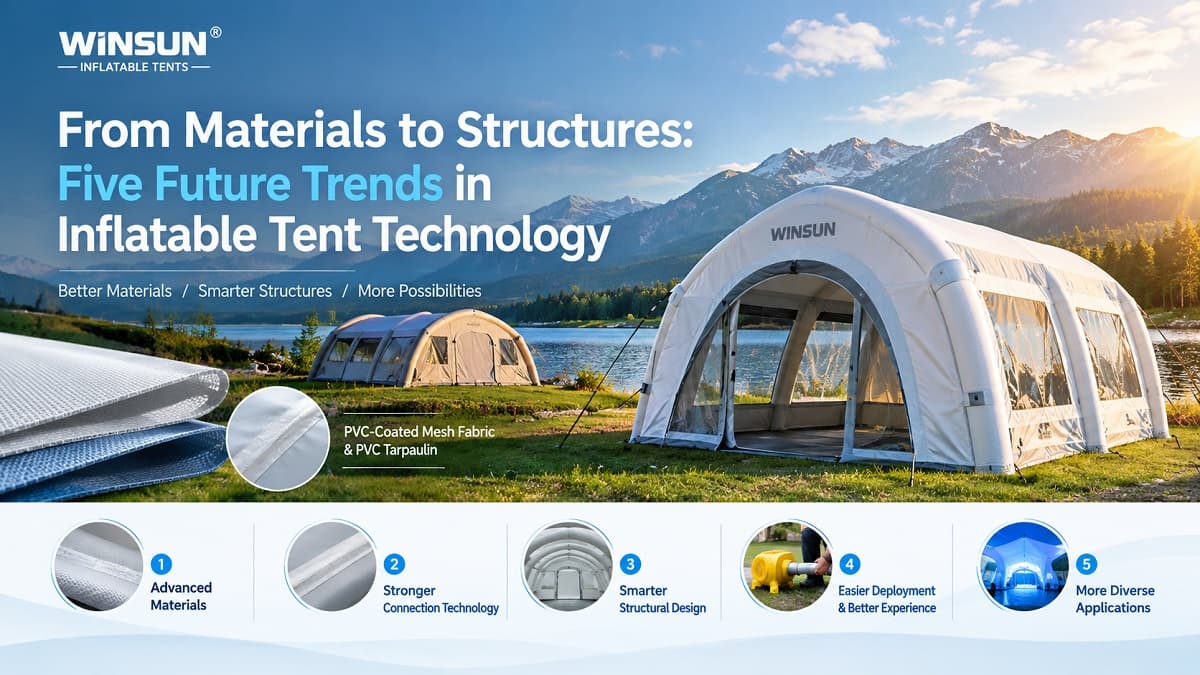
From Materials to Structures: Five Future Trends in Inflatable Tent Technology
Time:2026-09-15
Pageviews:0
Share:
Inflatable tents are evolving from simple temporary shelters into versatile structures for camping, events, emergency response, exhibitions, medical applications, and commercial outdoor spaces.

The technology behind these structures is also changing. Future development is not simply about making inflatable tents larger or adding more visual features. It is increasingly about better materials, smarter structural design, stronger connections, easier deployment, and more adaptable applications.

As a professional inflatable tent supplier specializing in PVC-coated mesh fabric and PVC tarpaulin, WINSUN works with both continuous-air inflatable tents and airtight inflatable tents. From material selection and manufacturing methods to structural engineering and application design, these technologies determine how an inflatable tent performs in real-world conditions.

Here are five important trends shaping the future of inflatable tent technology.


1. High-Performance Materials Will Become the Foundation of Better Inflatable Tents

The future of inflatable tents starts with the material.

An inflatable structure needs to balance several requirements at the same time: strength, flexibility, airtightness, weather resistance, cleanability, weight, and service life.

For professional inflatable tents, PVC-coated mesh fabric and PVC tarpaulin remain important material solutions because they can provide a practical balance between durability and flexibility.

Compared with ordinary consumer fabrics, commercial-grade PVC materials are designed for demanding outdoor applications. They can offer advantages such as:
• Excellent waterproof performance
• Strong resistance to outdoor use
• Good UV resistance
• Easy-to-clean surfaces
• High tear and abrasion resistance
• Suitable strength for repeated deployment
• Reliable performance for commercial applications

However, material selection should also match the type of inflatable structure.

Continuous-Air Inflatable Tents
Continuous-air tents remain inflated with a blower during use. Air continuously flows through the structure, maintaining the required pressure.

These products typically use sewn PVC-coated mesh fabric or PVC tarpaulin construction. The material needs to remain flexible enough for folding, transportation, installation, and repeated use.

For continuous-air inflatable tents, commonly used commercial material specifications may include 0.45mm, 0.55mm, and 0.6mm PVC materials, depending on the application and structural requirements.

Airtight Inflatable Tents
Airtight inflatable tents use closed air chambers. Once inflated, the structure can maintain its shape without continuous airflow from a blower.

These structures require reliable airtight seams. Therefore, high-temperature heat-welded construction is an essential manufacturing technology.

Airtight inflatable structures may use PVC materials up to approximately 0.9mm, depending on the product design and application.

The future is therefore not simply about using thicker material. Instead, it is about selecting the right material specification for the right structure and application.

The Key Trend
The next generation of inflatable tents will focus on material optimization rather than simply increasing material thickness.

Better coating technology, stronger base fabrics, improved welding performance, UV resistance, and more consistent production quality will help inflatable tents achieve better overall performance without unnecessary weight.


2. Seam and Connection Technology Will Become More Important

A strong inflatable tent is not created by fabric alone.

The way materials are connected is equally important.

In inflatable manufacturing, two major construction methods are widely used:

Sewing and high-temperature heat sealing/welding.

Each has a different role.

Sewing Construction
Sewn construction is commonly used for continuous-air inflatable structures.

The fabric panels are precisely cut and stitched together to create air channels and structural components. Professional sewing requires accurate cutting, controlled seam allowances, appropriate thread selection, and consistent stitching quality.

The advantage is flexibility.

Sewn inflatable structures can be designed with complex shapes, multiple air passages, decorative elements, and large continuous-air spaces.

Heat-Welded Construction
Airtight inflatable structures require a different approach.

Heat welding uses controlled temperature and pressure to bond PVC materials together. When properly manufactured, the welded seam creates an airtight connection between material panels.

This technology is especially important for:
• Airtight camping tents
• Emergency shelters
• Inflatable pavilions
• Medical and temporary structures
• Airtight inflatable halls
• Long-duration inflatable installations

The Future: More Precise Manufacturing
Future inflatable tent manufacturing will increasingly combine:

Digital pattern design → precision cutting → controlled sewing/welding → airtightness testing → quality inspection

This means manufacturing accuracy will become just as important as the raw material itself.

For inflatable structures, a small design or connection detail can influence the performance of the entire product.

The future of inflatable tents will therefore be built not only on better fabric, but also on better connection technology.


3. Structural Design Will Move Toward Lighter, Smarter and More Modular Systems

Inflatable tents have a unique structural advantage: air pressure can replace much of the rigid framework used by conventional tents.

Instead of relying primarily on metal poles, inflatable structures use internal air chambers or inflatable beams to create the supporting framework.

This opens the door to new structural possibilities.

Inflatable Architecture Without Traditional Frames
Traditional frame tents require transportation and assembly of multiple rigid components.

Inflatable tents can integrate structural support directly into the inflatable body.

This can reduce the number of separate components and simplify installation.

The result can be a system that is:
• Faster to deploy
• Easier to transport
• Easier to store
• More visually distinctive
• Adaptable to different applications

Modular Inflatable Structures
Another important direction is modularity.

Instead of designing one inflatable tent for only one purpose, future systems can combine multiple modules.

For example:

Inflatable Main Hall + Entrance Module + Side Room + Connecting Tunnel + Storage Module

This approach can allow users to create different configurations according to the event, site, capacity, or application.

A modular structure can also make it easier to expand or modify a temporary space without completely replacing the original system.

More Efficient Use of Internal Air Chambers
Structural design will also become more sophisticated.

Engineers can optimize the position, shape, and size of inflatable beams and air chambers to distribute loads more effectively.

The objective is not simply to create a larger air structure.

It is to create a structure that achieves the required stability, usable space, transportability, and durability with an efficient amount of material.


4. Deployment and User Experience Will Become Part of Structural Innovation

An inflatable tent is only useful if people can deploy and operate it efficiently.

For commercial users, event organizers, rental companies, emergency teams, and outdoor businesses, installation time can directly affect operating efficiency.

This is why future inflatable tent technology will increasingly focus on the complete deployment process.

From Product to Deployment System
A professional inflatable tent should be considered as a complete system:

Transportation → Unpacking → Positioning → Inflation → Anchoring → Inspection → Use → Deflation → Packing

Each step matters.

Designers are therefore looking for ways to make inflatable tents easier to understand and operate.

This may include:
• Clearly marked inflation points
• Integrated air valves
• Better-positioned blower connections
• More intuitive anchoring points
• Improved carrying and storage systems
• Modular components
• Faster inflation and deflation procedures
• Clear installation instructions

Easier Transportation
Transportation is another major consideration.

An inflatable structure may provide a large usable space when deployed but become relatively compact after deflation.

Future designs will pay greater attention to the relationship between:

Packed Size ↔ Weight ↔ Deployment Size ↔ Usable Interior Space

A tent that provides a large interior area but is difficult to transport may not be practical for mobile applications.

Therefore, packability will increasingly become part of structural design.


5. Smart and Application-Specific Inflatable Tents Will Open New Possibilities

The future of inflatable tents will not be defined by one universal design.

Instead, structures will increasingly be designed around specific applications.

Different users require different combinations of performance.

Outdoor Camping
Camping tents need to prioritize portability, weather resistance, ventilation, comfort, and quick setup.

Inflatable camping structures can combine flexible inflatable support with durable PVC-coated materials to create spacious interiors while simplifying installation.

Events and Exhibitions
Event tents may prioritize:
• Large open spaces
• Branding areas
• Unique architectural shapes
• Fast installation
• Reusable construction
• High visual impact

Inflatable pavilions can provide shapes that are difficult or expensive to achieve with traditional rigid structures.

Emergency and Temporary Shelters
Emergency applications place greater emphasis on:
• Rapid deployment
• Reliability
• Weather protection
• Interior space
• Easy transportation
• Repeated deployment

Airtight inflatable structures can be particularly suitable when long-duration inflation and independent air chambers are required.

Medical and Special-Purpose Applications
Specialized inflatable structures may require controlled internal environments, separated spaces, connecting corridors, or customized layouts.

This creates opportunities for application-specific structural engineering rather than one-size-fits-all products.

Smart Monitoring
Another future direction is the integration of monitoring technology.

Depending on the application, inflatable structures could incorporate sensors or monitoring systems to track factors such as:
• Internal pressure
• Temperature
• Environmental conditions
• Structural status
• Operating time

The purpose is not simply to add technology.

The real goal is to make inflatable structures easier to monitor, maintain, and manage.


The Future Is About the Whole System

The future of inflatable tent technology cannot be defined by one material, one welding method, or one structural concept.

It will come from the combination of multiple technologies.

Material + Construction + Air System + Structural Design + Deployment + Application

These elements work together.

A high-quality PVC material cannot compensate for poor seam construction.

A sophisticated structural design cannot compensate for incorrect material selection.

A durable inflatable tent can still be difficult to use if the deployment system is poorly designed.

The next generation of inflatable tents will therefore be developed as complete systems rather than simply as inflatable fabric products.


Continuous-Air vs. Airtight: Two Technologies, Different Advantages

Understanding the difference between continuous-air and airtight construction is essential when selecting an inflatable tent.

Feature Continuous-Air Inflatable Tent Airtight Inflatable Tent
Air System Continuous airflow Closed air chambers
Construction Mainly sewn construction Heat-welded construction
Blower Required during operation Mainly used for initial inflation
Typical Material Range Up to about 0.55–0.6mm Up to about 0.9mm
Deployment Fast and straightforward Fast after proper inflation
Typical Applications Events, camping, commercial temporary spaces Camping, shelters, pavilions, specialized structures
Main Design Focus Airflow and flexible structural design Airtightness and pressure retention

Neither technology is universally better.

The correct choice depends on the intended application, operating time, structural requirements, transportation needs, and expected usage conditions.


What This Means for Inflatable Tent Buyers

When evaluating an inflatable tent, looking only at the appearance or material thickness is not enough.

A professional buyer should consider the complete system.

1. What material is being used?
Ask about the fabric type, coating, material specification, and intended application.

2. How are the seams constructed?
Determine whether the structure uses sewing, heat welding, or a combination of different construction methods.

3. Is it continuous-air or airtight?
The air system directly influences installation, operation, maintenance, and structural design.

4. How is the structure anchored?
An inflatable tent still needs an appropriate anchoring system for its intended environment.

5. How easy is it to transport?
Consider packed dimensions, weight, carrying requirements, and storage.

6. Is the design suitable for repeated use?
Commercial applications require products designed around repeated deployment, cleaning, transportation, and storage.

7. Can the structure be customized?
For commercial events, exhibitions, branding, emergency response, and specialized applications, customization can be an important advantage.


WINSUN: Building Inflatable Structures from Material to Application

At WINSUN, we see inflatable tents as more than fabric structures.

They are engineered systems in which material, air pressure, construction technology, structural design, and application requirements must work together.

As a professional inflatable product manufacturer and supplier, WINSUN provides continuous-air and airtight inflatable tent solutions using commercial-grade PVC-coated mesh fabric and PVC tarpaulin.

Our capabilities cover different inflatable tent applications, including:
• Outdoor camping
• Events and festivals
• Exhibitions and promotional activities
• Inflatable pavilions
• Emergency and temporary shelters
• Medical and special-purpose structures
• Customized commercial inflatable spaces

From material selection and pattern development to sewing, heat welding, finishing, and quality inspection, every stage contributes to the performance of the final structure.

The future of inflatable tents is not simply about making them bigger.

It is about making them smarter, more efficient, more adaptable, easier to deploy, and better suited to the people who use them.

From the material to the structure, from the air system to the application, the next generation of inflatable tents is being built around one principle:

Better Engineering. Better Performance. Better Possibilities.

Looking for a custom inflatable tent for camping, events, exhibitions, emergency use, or a specialized application? Contact WINSUN to discuss your project.


Consultation Inquiries:
Email: Info@winsuntent.com
Website: www.winsuntent.com