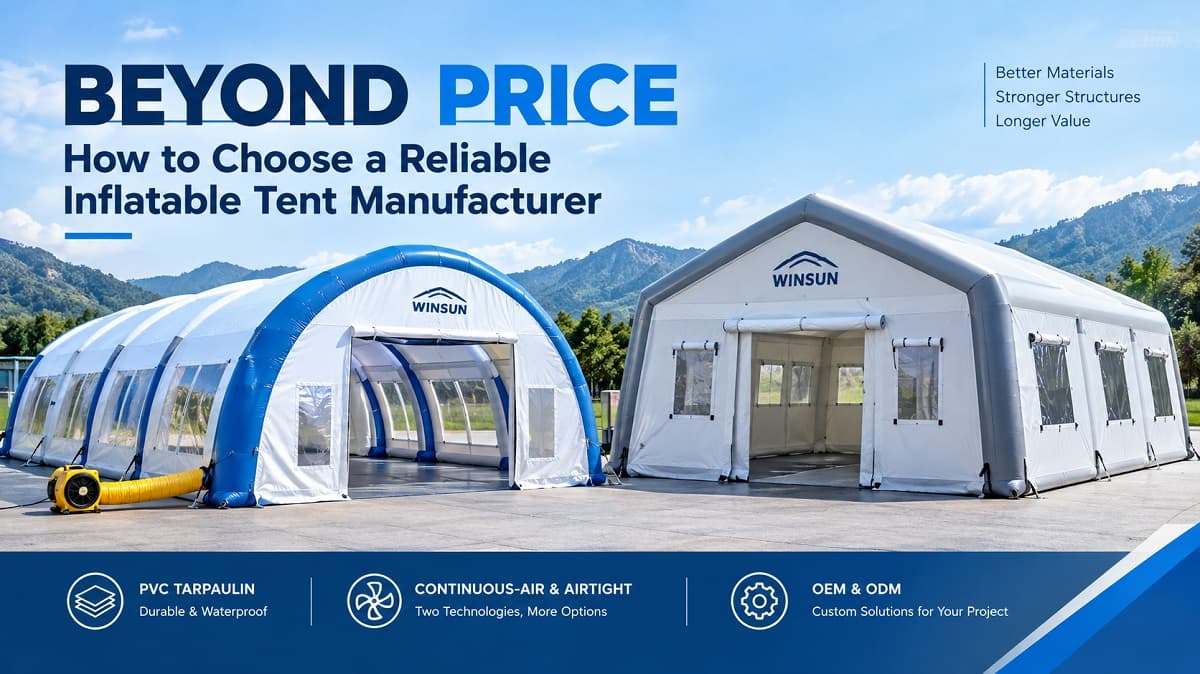
Beyond Price: How to Choose a Reliable Inflatable Tent Manufacturer?
Time:2026-10-12
Pageviews:0
Beyond Price: How to Choose a Reliable Inflatable Tent Manufacturer
When purchasing commercial inflatable tents, price is often one of the first factors buyers compare. However, for event rental companies, exhibition contractors, outdoor activity operators, camping businesses, and emergency shelter providers, the lowest quotation does not always represent the best value.
An inflatable tent is more than a fabric structure. Its material, construction method, air system, manufacturing quality, installation requirements, and long-term maintenance all influence its performance and operating costs.
Choosing the right manufacturer can help buyers reduce purchasing risks, improve equipment utilization, and build a more reliable product portfolio for their businesses.
So, how can you identify a reliable inflatable tent manufacturer beyond the price listed on a quotation?
Here are seven essential factors every commercial buyer should consider.
1. Check the Manufacturer's Material Expertise
Material quality is one of the foundations of a commercial inflatable tent.
Professional inflatable tents commonly use PVC tarpaulin, also known as PVC-coated fabric, which combines a textile reinforcement layer with a PVC coating. Depending on the material specification, it can provide waterproof performance, practical surface cleanability, and resistance to the demands of repeated commercial use.
However, not all PVC materials are the same. Buyers should look beyond general descriptions such as "heavy-duty PVC" and ask for more specific information.
Consider the following questions:
• What is the material thickness and specification?
• Is the material suitable for the intended application?
• How does the material perform under repeated folding, transportation, and installation?
• Is the surface suitable for cleaning and maintenance?
• Is the material specification appropriate for the tent's construction method?
Material thickness should be selected according to the intended application and structural design, rather than assuming that a thicker material is always better.
For many commercial designs, continuous-air inflatable tents use PVC tarpaulin in practical thicknesses up to approximately 0.55–0.6 mm, while airtight inflatable tents may use material up to approximately 0.9 mm, depending on the design.
A reliable manufacturer should be able to explain why a particular material specification is appropriate for your project.
2. Understand the Difference Between Continuous-Air and Airtight Inflatable Tents
Before comparing manufacturers, buyers should understand which inflatable tent technology best suits their business.
Continuous-air and airtight inflatable tents have different construction methods, operating requirements, and advantages. A manufacturer should clearly explain these differences instead of recommending the same type for every application.
Continuous-Air Inflatable Tents
Continuous-air inflatable tents rely on an air blower to maintain internal pressure during operation. Their air-retaining structures are generally made using sewn PVC tarpaulin construction.
They can be suitable for:
• Temporary event structures
• Exhibition and promotional activities
• Outdoor recreation
• Event rental operations
• Applications where frequent setup and takedown are expected
Buyers should evaluate the blower system, power requirements, airflow management, anchoring arrangements, and installation procedures.
Airtight Inflatable Tents
Airtight, or closed-air, inflatable tents are designed to retain air after inflation. Their air-retaining chambers are generally manufactured using heat-welded PVC tarpaulin.
They can be suitable for applications where reduced dependence on continuous power and extended air retention are important considerations.
Buyers should ask about air-retention performance, valve design, pressure requirements, inspection procedures, and recommended maintenance.
An airtight structure still requires appropriate pressure monitoring and inspection, and air retention should not be confused with unlimited or maintenance-free operation.
The key is to choose the right technology for your application. A professional manufacturer should help you evaluate the advantages and limitations of each construction method before you place an order.
3. Evaluate Manufacturing Capability, Not Just Product Photos
A professional-looking product image is useful, but it does not prove that a supplier can consistently manufacture commercial-grade inflatable tents.
Buyers should investigate the manufacturer's actual production capabilities.
Important factors include:
• Dedicated production facilities and equipment
• Experienced sewing and heat-welding technicians
• Printing and customization capabilities
• Material inspection procedures
• In-process quality checks
• Finished-product inspection
• Packaging and shipping preparation
The production process is particularly important for inflatable tents because different construction methods require different manufacturing expertise.
For continuous-air tents, buyers should pay attention to sewing quality, seam consistency, and the overall finish of the air chambers.
For airtight tents, heat-welded seams, connection details, valves, and air-retention testing are particularly important.
A reliable manufacturer should be able to explain its production process and describe how product quality is checked before shipment.
For larger orders, buyers should also ask how the factory maintains consistency across different units within the same production batch.
4. Ask About Quality Control and Testing
Quality control should not begin only after a product has been completed.
A reliable inflatable tent manufacturer should have a process for checking materials, workmanship, accessories, and finished products at appropriate stages of production.
Depending on the design, useful inspection points may include:
• Incoming material inspection
• Seam and connection inspection
• Dimensions and appearance checks
• Valve and blower checks, where applicable
• Inflation and pressure checks
• Air-retention checks for airtight structures
• Accessory and packaging verification
Buyers should also ask whether the manufacturer can provide inspection records, product specifications, operating instructions, and relevant test documentation.
If a supplier claims that a product meets a particular safety standard or certification requirement, request documentation that applies to the specific product and intended market.
It is important to distinguish between a manufacturer's general quality-control procedures and independently verified certifications.
For outdoor applications, quality control should also be supported by clear guidance on anchoring, wind limitations, installation, and safe operation.
A reliable supplier does not simply promise good quality. It can explain how quality is managed and what evidence is available.
5. Look for Genuine Customization and OEM/ODM Capability
Commercial projects rarely have identical requirements.
An exhibition contractor may need a branded pavilion. An event rental company may require several sizes of inflatable tents. A camping operator may want a specific layout, while a promotional agency may need custom colors and printed graphics.
This makes customization an important factor when selecting a manufacturer.
Before placing an order, confirm whether the supplier can support:
• Custom dimensions and shapes
• Logo printing and branded graphics
• Custom colors and visual themes
• Different door and window configurations
• Ventilation and layout requirements
• Project-specific structural designs
• OEM and ODM manufacturing
• Custom accessories and packaging
A capable manufacturer should also explain which design changes are feasible and how customization may affect production time, cost, and performance.
For example, changing a tent's dimensions or chamber layout may influence its transportation requirements, inflation system, anchoring arrangements, and material specification.
The best manufacturing partner is not simply the one that agrees to every request. It is the one that can evaluate your requirements and help develop a practical solution.
6. Compare Total Cost of Ownership, Not Just the Initial Price
Two inflatable tents with similar dimensions may have very different prices. Understanding the reasons behind those differences is essential.
A lower quotation may reflect differences in material specification, construction details, accessories, customization, testing, or after-sales service.
Instead of comparing prices alone, buyers should evaluate the total cost of ownership.
Consider these factors:
• Initial purchase cost: The price of the tent, required accessories, and agreed customization.
• Transportation and handling: Packaging dimensions, shipping arrangements, storage space, and ease of movement.
• Installation and operation: Labor requirements, blower power consumption for continuous-air structures, and other operating expenses.
• Maintenance and repairs: Access to repair materials, replacement components, technical instructions, and manufacturer support.
• Expected service life: The suitability of the materials and construction for the frequency and conditions of use.
• Downtime risk: The potential business impact of equipment problems during an event or rental period.
A more expensive product is not automatically better, just as a lower-priced product is not automatically a poor choice.
The objective is to understand what is included in the quotation and whether the specification matches your operating requirements.
For commercial buyers, the most cost-effective product is the one that provides the right balance of purchase price, performance, maintenance, and usable service life.
7. Evaluate Communication and After-Sales Support
A manufacturer's responsibility should not end when the order is shipped.
Commercial inflatable tents may require installation guidance, maintenance instructions, troubleshooting assistance, replacement accessories, or repair recommendations during their working life.
Before purchasing, ask the supplier:
• Can you provide clear product specifications and installation instructions?
• Will you explain the correct inflation and operating procedures?
• Can you recommend suitable anchoring arrangements?
• Are repair materials and replacement components available?
• Can you provide technical assistance if a problem occurs?
• What are the warranty terms and after-sales procedures?
Communication before production is equally important.
A professional supplier should confirm the dimensions, materials, colors, printing, accessories, packaging, and other order details before manufacturing begins.
For customized projects, clear drawings and written specifications can help prevent misunderstandings and reduce the risk of costly revisions.
Reliable communication is not merely a convenience. It is an important part of managing procurement risk.
A Practical Checklist Before Choosing an Inflatable Tent Manufacturer
Before confirming your order, use this checklist to compare potential suppliers.
• The manufacturer can explain the PVC tarpaulin specification.
• The recommended construction method suits the intended application.
• The supplier has relevant sewing or heat-welding expertise.
• Quality-control procedures are clearly explained.
• Product specifications and customization details are documented.
• Relevant test records and certifications can be provided where applicable.
• Accessories, installation requirements, and operating limitations are clear.
• Pricing includes a clearly defined scope of supply.
• Warranty terms, repair options, and technical support are explained.
• Production lead time, packaging, and delivery arrangements are confirmed.
Not every project requires the same level of customization or documentation. The important thing is to establish clear requirements before production starts.
Why Work with a Specialized Inflatable Tent Manufacturer?
A specialized manufacturer understands that continuous-air and airtight inflatable tents are not interchangeable products.
The choice of material, sewing or heat-welding method, air system, valves, dimensions, and operating requirements must work together as a complete design.
This expertise becomes especially valuable when buyers need custom products, larger structures, repeat orders, or solutions for demanding commercial applications.
Working directly with a manufacturer can also make communication about product specifications, customization, production, and quality control more straightforward.
For buyers developing a long-term product range or expanding a rental fleet, a stable manufacturing relationship can be just as valuable as a competitive quotation.
WINSUN: Your Partner for Commercial PVC Inflatable Tent Solutions
WINSUN specializes in PVC tarpaulin inflatable tent manufacturing, offering both continuous-air and airtight inflatable tent solutions for commercial and professional applications.
Continuous-Air Inflatable Tents
Featuring sewn PVC tarpaulin construction and continuous air supply, these tents can be developed for events, exhibitions, temporary activities, outdoor recreation, and other applications where convenient deployment is important.
Airtight Inflatable Tents
Featuring heat-welded PVC tarpaulin air chambers, these tents are designed for applications requiring air retention after inflation and reduced dependence on continuous blower operation.
Customized Manufacturing Solutions
WINSUN supports project-specific requirements, including custom sizes, shapes, colors, printing, configurations, and OEM/ODM development, subject to design feasibility.
From selecting a suitable construction method to confirming product specifications, our goal is to help customers identify inflatable tent solutions that fit their applications and commercial objectives.
When evaluating a supplier, we encourage buyers to look beyond the initial quotation and consider the complete product: materials, construction, manufacturing quality, customization, operating requirements, and long-term support.
Final Thoughts: Choose Value, Not Just the Lowest Price
Choosing a reliable inflatable tent manufacturer is a decision that can affect product performance, operating efficiency, customer satisfaction, and long-term business costs.
The right supplier should offer more than an attractive price. It should have the manufacturing expertise, technical knowledge, quality-control procedures, customization capabilities, and communication skills needed to support your project.
Before placing your next order, take the time to compare specifications, understand the construction method, verify important claims, and clarify the complete scope of supply.
The best manufacturing partner is not necessarily the cheapest one. It is the one that delivers the right product, at the right specification, with dependable support throughout the product's working life.
WINSUN — Professional PVC Inflatable Tent Manufacturer
Continuous-Air & Airtight | PVC Tarpaulin | OEM & ODM | Custom Solutions
Contact WINSUN to discuss your commercial inflatable tent project and find a solution tailored to your application.
Consultation Inquiries:
Email: Info@winsuntent.com
Website: www.winsuntent.com