NEWS
About the company's industry news
POSITION: Home > News
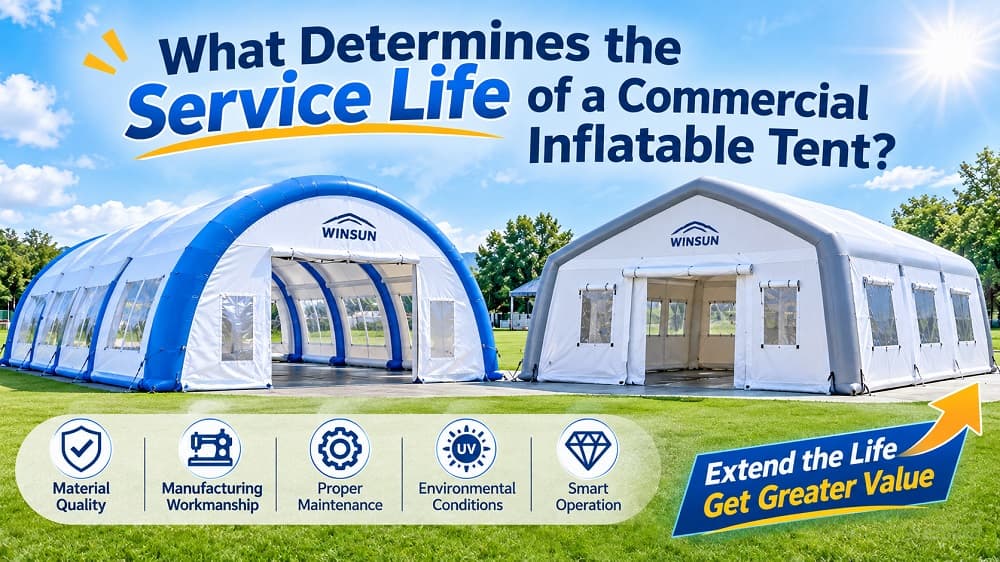
What Determines the Service Life of a Commercial Inflatable Tent?
Time:2026-11-03
Pageviews:0
Share:
For commercial inflatable tent buyers, durability is about much more than how a product looks when it is first delivered. Whether an inflatable tent is used for outdoor events, exhibitions, camping facilities, emergency shelters, or rental businesses, its service life directly affects operating costs, equipment replacement budgets, and long-term business value.

A commercial inflatable tent may be used repeatedly, transported between different locations, exposed to sunlight and changing weather conditions, and assembled and dismantled many times throughout its working life.

So, what determines how long an inflatable tent can last?

The answer involves several important factors, including material quality, manufacturing workmanship, construction technology, frequency of use, environmental conditions, storage, and maintenance.

As a professional manufacturer of PVC tarpaulin continuous-air and airtight inflatable tents, WINSUN explores the key factors that influence the service life of commercial inflatable structures and explains how buyers can make their investments last longer.
1. Material Quality: The Foundation of Long-Term Durability

The material is one of the most important factors determining the durability of an inflatable tent.

Commercial inflatable tents commonly use PVC tarpaulin, also known as PVC-coated fabric. This material combines a textile reinforcement layer with PVC coatings, providing a practical balance of strength, waterproof performance, flexibility, and ease of cleaning.

However, different PVC tarpaulin specifications are designed for different applications.

When selecting an inflatable tent, buyers should consider:
  • Material thickness: The thickness should match the tent structure and intended application.
  • Fabric reinforcement: The textile base contributes to the material's mechanical strength.
  • Coating quality: Consistent PVC coating helps provide waterproof performance and surface protection.
  • Flexibility: The material should be suitable for repeated folding, transportation, and installation.
  • Environmental suitability: UV exposure, temperature variations, moisture, and other environmental conditions should be considered.
For commercial inflatable tents, material thickness should be selected according to the construction method and structural requirements.

Typical material specifications include:
  • Continuous-air inflatable tents: PVC tarpaulin up to approximately 0.55–0.6 mm, depending on the design.
  • Airtight inflatable tents: PVC tarpaulin up to approximately 0.9 mm, depending on the design.
A thicker material does not automatically guarantee a longer service life. The overall material quality, reinforcement, flexibility, manufacturing process, and operating conditions all matter.

The right material is not necessarily the thickest one. It is the material that best matches the structure and its intended use.

2. Manufacturing Workmanship: Sewing and Heat-Welding Quality Matter

Even high-quality PVC tarpaulin cannot guarantee a durable inflatable tent if the manufacturing workmanship is poor.

Different inflatable tent technologies require different construction methods, and buyers should understand how these methods influence long-term performance.

Continuous-Air Inflatable Tents: Sewing Quality

Continuous-air inflatable tents rely on a blower to maintain internal air pressure during operation.

Their air-retaining structures are generally manufactured using sewn PVC tarpaulin construction.

Important manufacturing details include:
  • Consistent stitching and seam alignment
  • Appropriate sewing techniques
  • Reinforced connection areas
  • Proper treatment of stress points
  • Carefully finished corners and structural joints
Because the blower continuously supplies air, the tent can maintain its operating pressure while in use.

However, poor stitching, damaged seams, or excessive stress on connection areas may lead to air leakage or fabric damage over time.

Airtight Inflatable Tents: Heat-Welding Quality

Airtight or closed-air inflatable tents are designed to retain air after inflation, reducing the need for continuous blower operation.

Their air-retaining chambers are generally manufactured using heat-welded PVC tarpaulin rather than conventional sewing.

The quality of heat-welded connections is particularly important.

Manufacturers should pay attention to:
  • Consistent welding conditions
  • Uniform welded seams
  • Proper joint design
  • Reinforcement at critical connection areas
  • Valve installation and sealing
  • Air-retention inspection
Weak or inconsistent welded seams may cause gradual air leakage, affecting the structure's ability to maintain pressure.

For airtight inflatable tents, reliable welding workmanship is therefore essential to long-term performance.

A professional manufacturer must understand both technologies and apply the appropriate manufacturing process to each product.

3. Frequency of Use and Handling

How frequently an inflatable tent is used can significantly influence its service life.

A tent installed permanently or semi-permanently at one location may experience different types of wear compared with a rental tent that is transported and installed every week.

Frequent handling introduces additional stress through:
  • Repeated inflation and deflation
  • Folding and unfolding
  • Loading and unloading
  • Transportation
  • Ground contact
  • Repeated installation and dismantling
Over time, these activities may contribute to surface abrasion, creasing, stress around connection points, and damage to accessories.

For rental companies and event operators, proper handling procedures are especially important.

Recommended practices include:
  1. Follow the manufacturer's inflation and deflation instructions.
  2. Avoid dragging the tent across rough or abrasive surfaces.
  3. Use suitable equipment and sufficient personnel when moving large structures.
  4. Avoid sharp folds and unnecessary pressure on the same areas.
  5. Inspect the tent after transportation and before the next installation.
A well-designed commercial inflatable tent still requires proper handling to maintain its condition through repeated use.

4. UV Exposure and Outdoor Environmental Conditions

Outdoor inflatable tents are often exposed to sunlight, rain, wind, temperature changes, and other environmental factors.

Among these, prolonged UV exposure is particularly important because ultraviolet radiation can gradually affect PVC materials.

Depending on the material formulation and exposure conditions, long-term sunlight exposure may contribute to:
  • Surface fading
  • Reduced material flexibility
  • Surface aging
  • Changes in coating performance
  • Increased susceptibility to cracking or damage
Other environmental factors should also be considered.

Temperature: Very high or low temperatures may affect material flexibility and operating conditions.

Moisture: Storing a tent while it is still wet may encourage mold or mildew on contaminated surfaces and around folded areas.

Wind: Strong winds can place additional loads on the tent and its anchoring system.

Ground conditions: Rough surfaces, stones, sharp objects, and uneven ground may damage the bottom fabric.

Buyers should select materials appropriate for their intended environment and follow the manufacturer's operating limitations.

For outdoor installations, suitable ground protection, anchoring, and weather monitoring are essential.

5. Correct Inflation Pressure and Operating Conditions

Correct inflation pressure is another important factor affecting inflatable tent performance.

For continuous-air tents, the blower must provide the airflow and operating pressure specified for the design.

For airtight tents, the structure must be inflated according to the manufacturer's recommended pressure range.

Incorrect operating conditions may cause unnecessary stress on the material and structural connections.

Potential problems include:
  • Excessive pressure
  • Insufficient pressure
  • Incorrect blower selection
  • Blocked air inlets or outlets
  • Improper valve operation
  • Failure to monitor changing environmental conditions
For continuous-air tents, the blower and air supply system should be checked regularly.

For airtight tents, valves, air-retaining chambers, and pressure conditions should be inspected according to the manufacturer's instructions.

Buyers should never assume that adding more air will improve structural performance.

Following the correct inflation specifications helps protect the tent and maintain its intended operating performance.

6. Proper Cleaning, Drying, and Storage

Maintenance is one of the most practical ways to extend the working life of a commercial inflatable tent.

After outdoor use, tents may accumulate dust, mud, grass, moisture, and other contaminants.

If these are not properly removed, they may affect the material surface and create problems during storage.

A recommended maintenance routine includes:

Cleaning
  • Remove loose dirt and debris before packing.
  • Clean the PVC surface with water and a suitable mild cleaning solution.
  • Avoid harsh chemicals, solvents, and abrasive cleaning tools.
  • Follow the manufacturer's recommendations for stubborn stains.
Drying
  • Allow the tent to dry completely before long-term storage.
  • Pay attention to folded areas, corners, and internal surfaces where moisture may remain.
  • Avoid packing the tent while it is wet.
Storage
  • Store the tent in a clean, dry, and well-ventilated environment.
  • Keep it away from sharp objects and potential sources of damage.
  • Avoid prolonged exposure to direct sunlight during storage.
  • Use appropriate folding and packing methods.
  • Protect valves, accessories, and other vulnerable components.
For commercial rental businesses, establishing a standard cleaning and storage procedure after every event can help prevent avoidable damage.

7. Regular Inspection and Timely Repairs

Small problems can become larger ones if they are ignored.

Regular inspection allows operators to identify potential issues before they affect normal operation.

Before and after use, buyers should check:
  • PVC surfaces for cuts, scratches, or abrasion
  • Seams and welded joints
  • Corners and reinforced connection areas
  • Valves and air inlets
  • Blower connections and electrical components, where applicable
  • Anchoring points and attachment accessories
  • Signs of air leakage or unusual pressure changes
The repair method depends on the type of construction and the nature of the damage.

For continuous-air tents, repairs may involve appropriate PVC repair materials and professional sewing or patching procedures.

For airtight tents, repairs must restore the air-retaining properties of the affected area. Appropriate PVC repair and heat-welding techniques may be required.

Not every repair should be attempted with ordinary adhesive or general-purpose repair tape.

For larger damaged areas, structural connections, or repeated air leakage, buyers should consult the manufacturer for suitable repair instructions.

Early inspection and timely repair can help prevent minor damage from developing into more serious problems.

8. Design and Structural Details

The overall design of an inflatable tent also influences its durability.

A commercial tent must be designed to handle the loads and operating conditions associated with its intended application.

Important design considerations include:
  • Overall dimensions and structural proportions
  • Air chamber configuration
  • Connection and reinforcement details
  • Door and window construction
  • Ground-contact areas
  • Anchoring arrangements
  • Transportation and folding requirements
For example, a large event pavilion has different structural requirements from a small promotional tent.

Similarly, a tent designed for frequent transportation may need different construction details from one intended for longer-term installation.

Customization should therefore involve more than changing the external appearance.

A professional manufacturer should evaluate how changes in size, shape, layout, and configuration affect material requirements and structural performance.

9. Manufacturer Support and Maintenance Guidance

The service life of an inflatable tent is not determined by the product alone. The manufacturer's technical support also plays an important role.

Commercial buyers may need assistance with:
  • Installation procedures
  • Inflation and deflation instructions
  • Routine inspection
  • Cleaning and storage
  • Repair recommendations
  • Replacement valves and accessories
  • Troubleshooting
A reliable manufacturer should provide clear product specifications and practical operating guidance.

For rental companies and businesses operating multiple inflatable tents, access to technical assistance can make routine maintenance more efficient and help reduce equipment downtime.

When purchasing, buyers should ask about warranty coverage, repair support, available spare parts, and recommended maintenance procedures.

These details are worth considering before placing an order, not only after a problem occurs.

How Can You Extend the Service Life of a Commercial Inflatable Tent?

Although the exact service life varies according to product specifications and operating conditions, a consistent maintenance routine can help commercial operators protect their investment.

Here is a practical maintenance checklist:

Maintenance Stage Recommended Action
Before installation Inspect fabric, seams, valves, and accessories
During inflation Follow recommended pressure and blower instructions
During operation Monitor weather and avoid unsafe operating conditions
After use Remove dirt and inspect for damage
Before storage Clean and dry the tent completely
During storage Keep in a dry, protected environment
Periodically Perform detailed inspections and timely repairs

For frequently used rental equipment, inspection records can also be helpful.

Recording installation dates, maintenance activities, repairs, and observed problems allows operators to identify recurring issues and make better decisions about equipment management.

WINSUN: Manufacturing PVC Inflatable Tents for Commercial Applications

At WINSUN, we understand that commercial inflatable tents need to perform beyond their first installation.

As a professional PVC inflatable tent manufacturer, we focus on two main construction technologies to meet different customer requirements.

Continuous-Air Inflatable Tents

Manufactured using sewn PVC tarpaulin construction, continuous-air tents require a blower to maintain internal pressure during operation.

They can be customized for exhibitions, events, outdoor activities, temporary structures, and other commercial applications.

Our production considerations include material selection, sewing quality, structural connections, and practical operating requirements.

Airtight Inflatable Tents

Manufactured using heat-welded PVC tarpaulin air chambers, airtight tents are designed to retain air after inflation.

They are suitable for applications where reduced dependence on continuous blower operation and longer air retention are important.

Our manufacturing considerations include PVC material specifications, welding quality, connection details, valve installation, and air-retention inspection.

Custom Manufacturing and OEM/ODM Solutions

Different projects require different tent sizes, shapes, layouts, and visual designs.

WINSUN supports customization in:
  • Tent dimensions and structural configurations
  • PVC tarpaulin specifications
  • Colors and printed graphics
  • Doors, windows, and ventilation arrangements
  • Functional layouts
  • OEM and ODM projects
From individual custom tents to commercial project requirements, we aim to provide products that match the customer's application and operating environment.

Final Thoughts: Service Life Is the Result of the Entire Product Lifecycle

The service life of a commercial inflatable tent cannot be determined by material thickness or manufacturing quality alone.

It is the result of several factors working together:

Material Quality + Manufacturing Workmanship + Structural Design + Operating Conditions + Maintenance = Long-Term Performance

A well-manufactured inflatable tent, when properly installed, operated, cleaned, stored, and maintained, has a better opportunity to deliver reliable performance throughout its working life.

For commercial buyers, choosing the right material, construction method, and manufacturing partner is the first step. Following proper operating and maintenance procedures is the next.

At WINSUN, our goal is to help customers find practical PVC inflatable tent solutions designed for their applications, with attention to material selection, construction quality, and long-term usability.

WINSUN — Professional PVC Inflatable Tent Manufacturer

Continuous-Air & Airtight | PVC Tarpaulin | OEM & ODM | Custom Solutions

Contact WINSUN to discuss your inflatable tent project and find the right solution for your business.

Consultation Inquiries:
Email: Info@winsuntent.com
Website: www.winsuntent.com